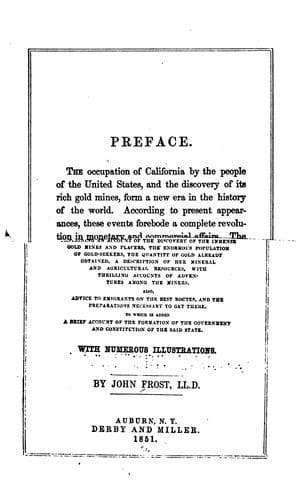
History of the State of California: From the Period of the Conquest by Spain to Her Occupation by the United States of AmericaFrost, John
History
History of the State of California: From the Period of the Conquest by Spain to Her Occupation by the United States of America
Frost, John
California -- Gold discoveries; California -- History
The legislation of Congress in regard to California has sometimes been
of a very unsatisfactory character. By an act passed in 1850, the
Secretary of the Treasury was authorized to contract upon the most
reasonable terms with the proprietors of some well-established
assaying works then in successful operation in California, who should
perform such duties in assaying and fixing the value of gold in grains
and lumps, and in forming the same into bars, as should be prescribed
by the Secretary of the Treasury, and the assayer was to fix the stamp
of the United States, indicating the degree of fineness and value,
upon each bar or ingot. This was a measure of convenience, and the
merchants of the California ports had then ample means of paying their
custom house duties. In 1852, however, Congress passed an act,
creating a branch mint of the United States in California: and to this
act was appended a clause, repealing the act which authorized the
office of Assayer, as soon as public notice was given of the creation
of the branch mint. In consequence of this legislation, the Assayer's
office was abolished, and yet there was no mint for coining in the
golden land. Time was required for making the necessary appropriation
of money, erecting buildings, and constructing machinery, all of which
had not been considered. The clause of the former act which made the
stamped ingots receivable for duties was repealed. The merchants of
California had no means of paying their duties at the custom house,
and great excitement and confusion ensued. Finally, an arrangement was
made with the Collector of San Francisco, under which uncoined gold
could be received in payment of duties, and then business went on as
usual. Care is one of the first essentials of beneficial legislation.
The circumstance that the people of California are so far from the
seat of the federal government, requires a strict attention in
legislators, to prevent evils which cannot be quickly remedied.
The people of California seem to be deeply interested in the
construction of a great railroad from the Mississippi to the Pacific.
At San Diego, several meetings have been held, and reports adopted,
advocating and exhibiting the advantages of a southern route for the
proposed railroad. The route which the meetings favored is to start
from the Gulf of Mexico or some of its tributaries, and passing
through Texas, Louisiana, and New Mexico to California, and strike the
Pacific at San Diego. Its entire length would not exceed sixteen
hundred miles, whilst it would have the advantages, as alleged by the
report, of passing through a section in which universal summer
prevails, and of affording opportunities for lateral roads connecting
with the cities of Mexico, through which a large trade might be
obtained. The subject has been brought to the consideration of
Congress, and that body has prudently appropriated a large sum for a
survey of the various routes proposed.
APPENDIX.
APPENDIX A.
Public-domain text, read in full here on John Shaqi.
Reviews
Reviews
No reviews yet
Be the first to share your thoughts on this work.
Elsewhere in the archive
Join the Discussion
Join the discussion
Sign in to leave a comment or review.
Sign InorCreate an account