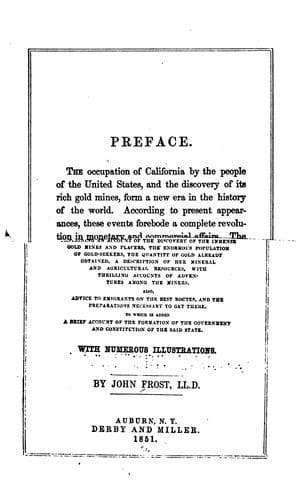
History of the State of California: From the Period of the Conquest by Spain to Her Occupation by the United States of AmericaFrost, John
History
History of the State of California: From the Period of the Conquest by Spain to Her Occupation by the United States of America
Frost, John
California -- Gold discoveries; California -- History
Among the new and most remarkable _placers_, are the gold bluffs,
situated near the mouth of the Klamath river, about thirty miles north
of Trinidad. The approach to them by land is over a plain of sand,
into which the traveller sinks ankle-deep at every step. The bluffs
stretch along some five or six miles, and present a perpendicular
front to the ocean of from 100 to 400 feet in height. In ordinary
weather the beach is from 20 to 50 feet in width, composed of a
mixture of gray and black sand, the latter containing the gold in
scales so fine that they cannot be separated by the ordinary process
of washing; so that resort must be had to chemical means. The beach
changes with every tide, and sometimes no black, auriferous sand is to
be seen on the surface. By digging down, it is found mixed with gray
sand, which largely predominates. The violence of the surf renders
landing in boats impracticable. When the beach was discovered early in
1851, several tons of goods were landed from a steamer despatched
thither, by means of lines from the vessel to the shore. The Pacific
Mining Company have made good profits in working the bluffs and the
sand of the beach.
Tunneling has been carried on quite extensively in the mining region.
Some of the tunnels through solid rock are wonderful achievements. At
Duggan's Flat, a party bored 150 feet in the solid rock before finding
the gold.
Professor Forrest Shepherd, of New Haven, has made some remarkable
discoveries of thermal action in California. In one place where there
was nothing on the surface to attract attention, on digging down the
heat increased so rapidly that at the depth of two feet he could not
bear his hand in the earth, and the thermometer indicated a
temperature of 130 degrees. At another place, after wandering for four
days through dense thickets, he came upon a chasm a thousand feet
deep, through which flowed a stream, the banks of which, on the 8th of
February, were covered with vegetation. Following up the stream, the
earth grew so hot as to burn the feet through the boots. There was no
appearance of lava, and the rocks were being dissolved by a powerful
_catalytic_ action. From innumerable orifices steam was forced to the
height of two hundred feet. The number of spouting geysers and boiling
springs, on a half mile square, exceeded two hundred. The Professor,
in the course of a lecture delivered at San Jose, said he did not
doubt that silver, lead, and iron abounded in California.
Public-domain text, read in full here on John Shaqi.
Reviews
Reviews
No reviews yet
Be the first to share your thoughts on this work.
Elsewhere in the archive
Join the Discussion
Join the discussion
Sign in to leave a comment or review.
Sign InorCreate an account