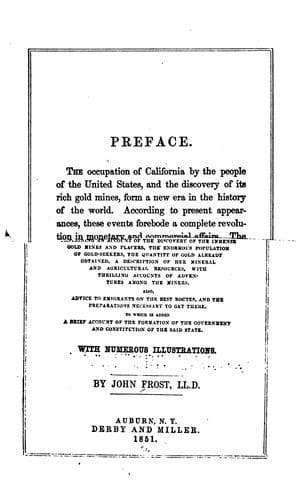
History of the State of California: From the Period of the Conquest by Spain to Her Occupation by the United States of AmericaFrost, John
History
History of the State of California: From the Period of the Conquest by Spain to Her Occupation by the United States of America
Frost, John
California -- Gold discoveries; California -- History
The powers of the government of the State of California shall be
divided into three separate departments: the Legislature, the
Executive, and Judicial; and no person charged with the exercise of
powers properly belonging to one of these departments, shall exercise
any functions appertaining to either of the others; except in the
cases hereinafter expressly directed or permitted.
ARTICLE IV.
LEGISLATIVE DEPARTMENT.
SEC. 1. The legislative power of this State shall be vested in a
Senate and Assembly, which shall be designated the Legislature of the
State of California, and the enacting clause of every law shall be as
follows: "The people of the State of California, represented in Senate
and Assembly, do enact as follows."
SEC. 2. The sessions of the Legislature shall be annual, and shall
commence on the first Monday of January, next ensuing the election of
its members; unless the Governor of the State shall, in the interim,
convene the Legislature by proclamation.
SEC. 3. The members of the Assembly shall be chosen annually, by the
qualified electors of their respective districts, on the Tuesday next
after the first Monday in November, unless otherwise ordered by the
Legislature, and their term of office shall be one year.
SEC. 4. Senators and Members of Assembly shall be duly qualified
electors in the respective counties and districts which they
represent.
SEC. 5. Senators shall be chosen for the term of two years, at the
same time and places as Members of Assembly; and no person shall be a
Member of the Senate or Assembly, who has not been a citizen and
inhabitant of the State one year, and of the county or district for
which he shall be chosen six months next before his election.
SEC. 6. The number of Senators shall not be less than one third, nor
more than one half, of that of the Members of Assembly; and at the
first session of the Legislature after this Constitution takes effect,
the Senators shall be divided by lot as equally as may be, into two
classes; the seats of the Senators of the first class shall be vacated
at the expiration of the first year, so that one half shall be chosen
annually.
SEC. 7. When the number of Senators is increased, they shall be
apportioned by lot, so as to keep the two classes as nearly equal in
number as possible.
SEC. 8. Each house shall choose its own officers, and judge of the
qualifications, elections, and returns of its own members.
SEC. 9. A majority of each house shall constitute a quorum to do
business; but a smaller number may adjourn from day to day, and may
compel the attendance of absent members, in such manner, and under
such penalties as each house may provide.
SEC. 10. Each house shall determine the rules of its own proceedings,
and may with the concurrence of two-thirds of all the members elected,
expel a member.
Public-domain text, read in full here on John Shaqi.
Reviews
Reviews
No reviews yet
Be the first to share your thoughts on this work.
Elsewhere in the archive
Join the Discussion
Join the discussion
Sign in to leave a comment or review.
Sign InorCreate an account