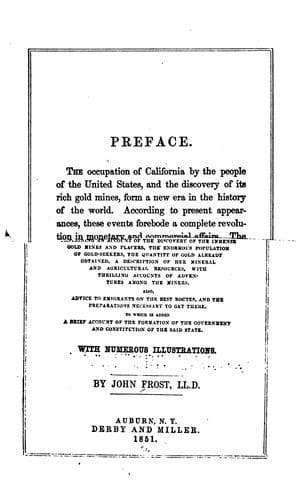
History of the State of California: From the Period of the Conquest by Spain to Her Occupation by the United States of AmericaFrost, John
History
History of the State of California: From the Period of the Conquest by Spain to Her Occupation by the United States of America
Frost, John
California -- Gold discoveries; California -- History
"From the mill [where the gold was first discovered], Mr. Marshall
guided me up the mountain on the opposite or north bank of the south
fork, where, in the bed of small streams or ravines, now dry, a great
deal of coarse gold has been found. I there saw several parties at
work, all of whom were doing very well; a great many specimens were
shown me, some as heavy as four or five ounces in weight, and I send
three pieces, labeled No. 5, presented by a Mr. Spence. You will
perceive that some of the specimens accompanying this, hold
mechanically pieces of quartz; that the surface is rough, and
evidently moulded in the crevice of a rock. This gold cannot have been
carried far by water, but must have remained near where it was first
deposited from the rock that once bound it. I inquired of many people
if they had encountered the metal in its matrix, but in every instance
they said they had not; but that the gold was invariably mixed with
washed gravel, or lodged in the crevices of other rocks. All bore
testimony that they had found gold in greater or less quantities in
the numerous small gullies or ravines that occur in that mountainous
region.
"On the 7th of July I left the mill, and crossed to a stream emptying
into the American Fork, three or four miles below the saw-mill. I
struck this stream (now known as Weber's creek) at the washings of
Sunol and Co. They had about thirty Indians employed, whom they payed
in merchandise. They were getting gold of a character similar to that
found in the main fork, and doubtless in sufficient quantities to
satisfy them. I send you a small specimen, presented by this company,
of their gold. From this point, we proceeded up the stream about eight
miles, where we found a great many people and Indians--some engaged in
the bed of the stream, and others in the small side valleys that put
into it. These latter are exceedingly rich, and two ounces were
considered an ordinary yield for a day's work. A small gutter not more
than a hundred yards long, by four feet wide and two or three feet
deep, was pointed out to me as the one where two men--William Daly and
Parry McCoon--had, a short time before, obtained $17,000 worth of
gold. Captain Weber informed me that he knew that these two men had
employed four white men and about a hundred Indians, and that, at the
end of one week's work, they paid off their party, and had left
$10,000 worth of this gold. Another small ravine was shown me, from
which had been taken upward of $12,000 worth of gold. Hundreds of
similar ravines, to all appearances, are as yet untouched. I could not
have credited these reports, had I not seen, in the abundance of the
precious metal, evidence of their truth.
Public-domain text, read in full here on John Shaqi.
Reviews
Reviews
No reviews yet
Be the first to share your thoughts on this work.
Join the Discussion
Join the discussion
Sign in to leave a comment or review.
Sign InorCreate an account