History of the State of California: From the Period of the Conquest by Spain to Her Occupation by the United States of America — John Shaqi
History of the State of California: From the Period of the Conquest by Spain to Her Occupation by the United States of AmericaFrost, John
History
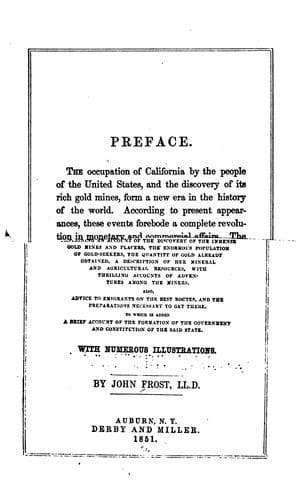
History of the State of California: From the Period of the Conquest by Spain to Her Occupation by the United States of America
Frost, John
California -- Gold discoveries; California -- History
The peninsula of California is about one hundred and thirty miles in
breadth, where it joins the continent. It extends south-eastwardly,
generally diminishing in breadth, till it terminates in two points.
The point farthest south-west is called Cape San Lucas. The other,
sixty miles east by north of San Lucas, is called Cape Palmo. The
peninsula is about seven hundred miles long.
Upper California extends, upon the Pacific, from the 32d parallel of
latitude, northward to the 42d parallel, a distance of about seven
hundred miles. It is separated from Oregon by a range of highlands,
called the Snowy Mountains, or, by the Spaniards, the Sierra Nevada.
The eastern limit of Upper California is rather uncertain. By some it
is considered as including the region watered by the Colorado River,
while others limit it by the great mountain range that extends along
the western side of the continent.
The Californian peninsula seems to be a prolongation of the great
western chain of mountains. It consists entirely of high, stony
ridges, separated by sandy valleys, and contains very few tracts of
level ground. In a general view, it might be termed an irreclaimable
desert. The scarcity of rain and the small number of springs of water,
with the intense heat of the sun's rays, uninterrupted in their
passage, render the surface of the country almost destitute of
vegetation. Yet in the small oases formed by the passage of a rivulet
through a sandy defile, where irrigation is possible, the ground may
be made to produce all the fruits of tropical climes, of the finest
quality, and in great quantity. The southern portion of the peninsula
contains several gold mines, which have been worked, though not to any
great extent. On the Pacific side, the coast offers many excellent
harbors, but the lack of fresh water near them proves an obstacle in
the way of their occupation. The principal harbors are the Bay of la
Magdalena, separated from the ocean by the long island of Santa
Margarita, the Bay of Sebastian Vizcaino, east of the Isle of Cedaro,
Port San Bartolomé, sometimes called Turtle Bay, and Port San Quintin,
a good harbor, with fresh water in the vicinity, and called by the
Spanish navigators the Port of the Eleven Thousand Virgins.
Public-domain text, read in full here on John Shaqi.
Reviews
Reviews
No reviews yet
Be the first to share your thoughts on this work.
Join the Discussion
Join the discussion
Sign in to leave a comment or review.
Sign InorCreate an account