History of the State of California: From the Period of the Conquest by Spain to Her Occupation by the United States of America — John Shaqi
History of the State of California: From the Period of the Conquest by Spain to Her Occupation by the United States of AmericaFrost, John
History
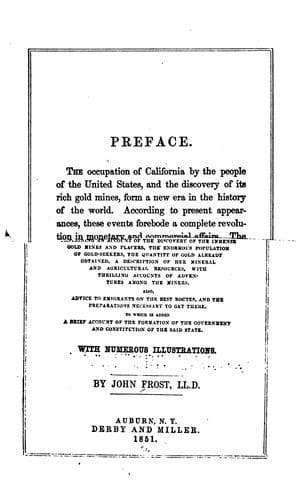
History of the State of California: From the Period of the Conquest by Spain to Her Occupation by the United States of America
Frost, John
California -- Gold discoveries; California -- History
"The danger of apprehension is small, and the prospect of high wages
certain; pay and bounties are trifles, as laboring men at the mines
can now earn in one day more than double a soldier's pay and
allowances for a month, and even the pay of a lieutenant or captain
cannot hire a servant. A carpenter or mechanic would not listen to an
offer of less than fifteen or twenty dollars a day. Could any
combination of affairs try a man's fidelity more than this? I really
think some extraordinary mark of favor should be given to those
soldiers who remain faithful to their flag throughout this tempting
crisis.
"Many private letters have gone to the United States, giving accounts
of the vast quantity of gold recently discovered, and it may be a
matter of surprise why I have made no report on this subject at an
earlier date. The reason is, that I could not bring myself to believe
the reports that I heard of the wealth of the gold district until I
visited it myself. I have no hesitation now in saying that there is
more gold in the country drained by the Sacramento and San Joaquin
Rivers than will pay the cost of the present war with Mexico a hundred
times over. No capital is required to obtain this gold, as the
laboring man wants nothing but his pick and shovel and tin pan, with
which to dig and wash the gravel; and many frequently pick gold out of
the crevices of the rocks with their butcher knives, in pieces of from
one to six ounces.
"Mr. Dye, a gentleman residing in Monterey, and worthy of every
credit, has just returned from Feather River. He tells me that the
company to which he belonged worked seven weeks and two days, with an
average of fifty Indians (washers,) and that their gross product was
two hundred and seventy-three pounds of gold. His share (one seventh,)
after paying all expenses, is about thirty-seven pounds, which he
brought with him and exhibited in Monterey. I see no laboring man from
the mines who does not show his two, three, or four pounds of gold. A
soldier of the artillery company returned here a few days ago from the
mines, having been absent on furlough twenty days. He made by trading
and working, during that time, $1500. During these twenty days he was
travelling ten or eleven days, leaving but a week in which he made a
sum of money greater than he receives in pay, clothes, and rations,
during a whole enlistment of five years. These statements appear
incredible, but they are true.
"Gold is also believed to exist on the eastern slope of the Sierra
Nevada; and when at the mines, I was informed by an intelligent Mormon
that it had been found near the Great Salt Lake by some of his
fraternity. Nearly all the Mormons are leaving California to go to the
Salt Lake, and this they surely would not do unless they were sure of
finding gold there in the same abundance as they now do on the
Sacramento.
Public-domain text, read in full here on John Shaqi.
Reviews
Reviews
No reviews yet
Be the first to share your thoughts on this work.
Join the Discussion
Join the discussion
Sign in to leave a comment or review.
Sign InorCreate an account