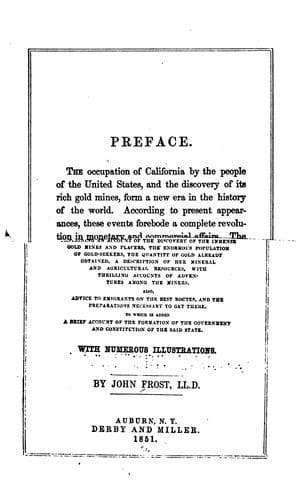
History of the State of California: From the Period of the Conquest by Spain to Her Occupation by the United States of AmericaFrost, John
History
History of the State of California: From the Period of the Conquest by Spain to Her Occupation by the United States of America
Frost, John
California -- Gold discoveries; California -- History
[3] See Farnham's Adventures. Wilkes's and Fremont's Narratives, and
Emory's Report.--In 1846, Eugenio Macnamara, a Catholic priest and
Missionary, obtained a grant of a large tract of land between the San
Joaquin and the Sierra Nevada, the Cosumnes and the Tulares in the
vicinity of San Gabriel, from Pio Pico, governor of the Californias,
for the purpose of establishing upon it a large colony of Irish
Catholics; but the grant was not ratified by the Central Government,
and the project was not carried into effect. There is no evidence that
Father Macnamara was aware of the existence of gold in the valley of
the San Joaquin.
[4] Official Despatch of Colonel Mason, Commander of the 10th Military
Department, August 17, 1848.--Letters of Thomas C. Larkin, U.S. Consul
at Monterey, to the Secretary of State, June 1, and June 28, 1848.
[5] Feather River is the first considerable branch of the Sacramento
below the _Prairie Buttes_. It has a course of about forty miles, and
empties into the main river about fifteen miles above New Helvetia.
Though the Sacramento is navigable for vessels only to that place,
boats can pass up one hundred miles further.
CHAPTER VII.
ADVENTURES OF SOME OF THE MINERS, AND INCIDENTS CONNECTED
WITH MINING.
The adventures of the eager gold-seekers in the region of their hopes,
among the washings and the diggings of the _placers_, cannot but be
interesting. The toil to which the men have to submit if they would
obtain any thing like a satisfaction to their desires, is of a very
irksome character. In the summer season, the heat is intense, and the
principal part of the labor of washing and digging must be performed
exposed to the full blaze of the sun. In the "dry diggings," the
miners suffer greatly from the want of water. Most of the provisions
having to be transported from the towns on the Sacramento and San
Joaquin, soon grow unwholesome from exposure to the sultry air of the
day and the damp air of the night. This diet, conjointly with the
exposure of the miners, tends to produce intermittent fever and
dysentery. The miners generally reside in huts of a rude construction,
or in canvas tents, which afford but poor protection from the changes
of the weather.
Public-domain text, read in full here on John Shaqi.
Reviews
Reviews
No reviews yet
Be the first to share your thoughts on this work.
Join the Discussion
Join the discussion
Sign in to leave a comment or review.
Sign InorCreate an account