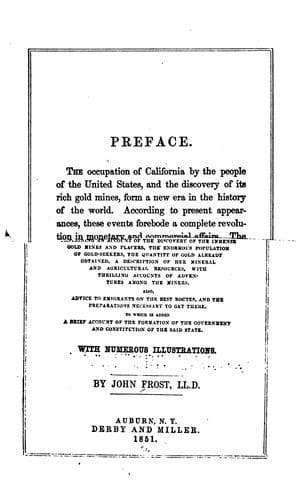
History of the State of California: From the Period of the Conquest by Spain to Her Occupation by the United States of AmericaFrost, John
History
History of the State of California: From the Period of the Conquest by Spain to Her Occupation by the United States of America
Frost, John
California -- Gold discoveries; California -- History
"I walked on until I reached the trading-post of Mr. Anderson,
formerly our interpreter in the Lower Country, whom I felt delighted
to meet with again. His shed was situated in one of the dampest parts
of the mine, and consisted of a few upright poles, traversed by
cross-pieces, and covered in with raw hides and leaves, but yet much
exposed at the sides to the wind and the weather. He had a few barrels
of flour and biscuit, which he retailed at two dollars a pound; for he
made no difference between the price of the raw and the prepared
material. The flour would go further, it was true; but then the
biscuit required no cooking on the part of the miner, whose time was
literally money, and whose interest therefore it was to economize it
in every possible manner. He also sold unprepared coffee and sugar at
six Yankee shillings a pound; dried beef at one dollar and a half; and
pork, which was regarded as a great delicacy here, at two dollars for
the same weight. The various articles of which his stock-in-trade
consisted he had brought all the way from Monterey at considerable
labor and expense; but, by the exercise of extraordinary tact,
perseverance, and industry, he had succeeded in establishing a
flourishing business.
"I discovered, however, that he possessed another resource--by which
his gains were marvellously increased--in the services of seven or
eight Indians, whom he kept constantly at work, in the rear of his
shed, digging gold, and whose labor he remunerated with provisions,
and occasional presents of articles of trifling value to him, but
highly esteemed by the Indians. They were watched by an American
overseer, who was employed by him, to assist in the general business,
particularly in slaughtering; for, as beef was scarce, he used to send
his man in quest of cows and oxen; which he killed, cut up, salted and
dried, in his shed, and watching the most favorable moment for the
operation--namely, when meat could not be procured at the
'diggins'--never failed to realize his own price for it.
Public-domain text, read in full here on John Shaqi.
Reviews
Reviews
No reviews yet
Be the first to share your thoughts on this work.
Join the Discussion
Join the discussion
Sign in to leave a comment or review.
Sign InorCreate an account