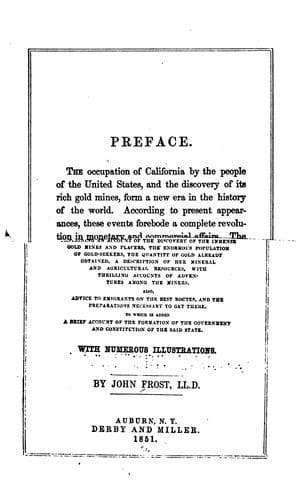
History of the State of California: From the Period of the Conquest by Spain to Her Occupation by the United States of America — John Shaqi
History of the State of California: From the Period of the Conquest by Spain to Her Occupation by the United States of AmericaFrost, John
History
History of the State of California: From the Period of the Conquest by Spain to Her Occupation by the United States of America
Frost, John
California -- Gold discoveries; California -- History
"Continuing my route up the ravine, I met a man named Corrigan,
galloping along with two fine horses, one of which he was leading. He
stopped as soon as he recognized me, and we were soon engaged in a
very interesting conversation respecting the doings at the 'diggins.'
The substance of his information was, that he had made a great deal of
money at the mines by digging, but infinitely more by speculation. He
thought of buying a _ranché_, marrying, and settling down. He was then
going to seek for pasture for his horses; and, bidding me a hasty
good-bye, galloped off, and soon disappeared.
"As I advanced, the ground became drier and more sandy, rock and slate
of various kinds abounding; some quite soft and friable, yielding
readily to the pickaxe or the crowbar; and, in other places, so hard
as to resist the utmost strength of the miners. Several of the diggers
were perseveringly exploring the localities where the rotten sorts of
slate were found in the largest quantities, and I saw them pick out a
good deal of gold with their jack-knives. Their principal aim was to
discover what they termed 'a pocket,' which is nothing more than a
crevice between the blocks of slate, into which a deposit of gold has
been washed by the heavy rains from the higher districts, and which,
soon accumulating, swell into rapid torrents, which rush down these
ravines with extraordinary swiftness and force, sweeping every thing
before them.
"There did not appear to be many mining parties at the Stanislaus at
this particular period, for the encampments were generally from two to
five miles apart, the space between them increasing the higher you
advanced towards the mountains, to the foot of which the ravine
extended--altogether, a distance of many miles. The lower part of the
mine, I concluded from this fact, to be by far the richer, simply from
the circumstance I have mentioned; richer, comparatively, because here
the deposits of gold are more easily found and extracted; not richer,
in reality, as the metal must exist in immense quantities in the upper
regions, from which it is washed down by the rains and floods into the
lower districts. The virgin deposit would, doubtless, be difficult to
come at; but, if sought after at all, that it is to be sought in the
mountains and high lands, I feel persuaded.
"I turned back, after prosecuting my excursion until the ravine became
almost too rocky to allow me to proceed, and until I saw that the
'diggins' diminished materially in number. On clambering the hills at
the side, I beheld abundance of pines, oak, cedar, and palm; but no
grass, nor vegetation of any other kind, save prickly shrubs, with
here and there a patch of extremely dry moss. On my way back, I passed
several tents and huts erected by the miners, all of the very poorest
and most wretched description.
Public-domain text, read in full here on John Shaqi.
Reviews
Reviews
No reviews yet
Be the first to share your thoughts on this work.
Join the Discussion
Join the discussion
Sign in to leave a comment or review.
Sign InorCreate an account