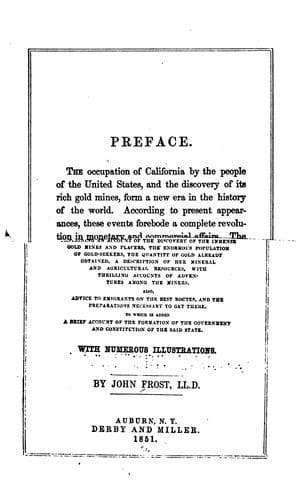
History of the State of California: From the Period of the Conquest by Spain to Her Occupation by the United States of AmericaFrost, John
History
History of the State of California: From the Period of the Conquest by Spain to Her Occupation by the United States of America
Frost, John
California -- Gold discoveries; California -- History
"It is a well-established theory, that the currents of air under which
the earth passes in its diurnal revolutions, follow the line of the
sun's greatest attraction. These currents of air are drawn towards
this line from great distances on each side of it; and, as the earth
revolves from west to east, they blow from north-east and south-east,
meeting, and, of course, causing a calm, on the line.
"Thus, when the sun is directly, in common parlance, over the equator,
in the month of March, these currents of air blow from some distance
north of the Tropic of Cancer, and south of the Tropic of Capricorn,
in an oblique direction towards this line of the sun's greatest
attraction, and forming what are known as the north-east and
south-east trade winds.
"As the earth, in its path round the sun, gradually brings the _line_
of attraction north, in summer, these currents of air are carried
_with_ it; so that about the middle of May the current from the
north-east has extended as far as the 38th or 39th degree of north
latitude, and by the twentieth of June, the period of the sun's
greatest northern inclination, to the northern portions of California
and the southern section of Oregon.
"These north-east winds, in their progress across the continent,
towards the Pacific Ocean, pass over the snow-capped ridges of the
Rocky Mountains and the Sierra Nevada, and are, of course, deprived
of all the moisture which can be extracted from them by the low
temperature of those regions of eternal snow, and consequently no
moisture can be precipitated from them, in the form of dew or rain, in
a higher temperature than that to which they have been subjected.
They, therefore, pass over the hills and plains of California, where
the temperature is very high in summer, in a very dry state; and, so
far from being charged with moisture, they absorb, like a sponge, all
that the atmosphere and surface of the earth can yield, until both
become, apparently, perfectly dry.
"This process commences, as I have said, when the line of the sun's
greatest attraction comes north in summer, bringing with it these vast
atmospheric movements, and, on their approach, produce the dry season
in California; which, governed by these laws, continues until some
time after the sun repasses the Equator in September, when, about the
middle of November, the climate being relieved from these north-east
currents of air, the south-west winds set in from the ocean charged
with moisture--the rains commence and continue to fall, not
constantly, as some persons have represented, but with sufficient
frequency to designate the period of their continuance, from about the
middle of November until the middle of May, in the latitude of San
Francisco, as the _wet season_.
Public-domain text, read in full here on John Shaqi.
Reviews
Reviews
No reviews yet
Be the first to share your thoughts on this work.
Elsewhere in the archive
Join the Discussion
Join the discussion
Sign in to leave a comment or review.
Sign InorCreate an account