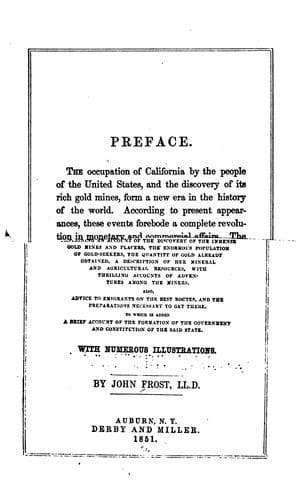
History of the State of California: From the Period of the Conquest by Spain to Her Occupation by the United States of AmericaFrost, John
History
History of the State of California: From the Period of the Conquest by Spain to Her Occupation by the United States of America
Frost, John
California -- Gold discoveries; California -- History
"It follows, as a matter of course, that the _dry season_ commences
first, and continues longest in the southern portions of the
territory, and that the climate of the northern part is influenced in
a much less degree, by the causes which I have mentioned, than any
other section of the country. Consequently, we find that, as low down
as latitude 39°, rains are sufficiently frequent in summer to render
irrigation quite unnecessary to the perfect maturity of any crop which
is suited to the soil and climate.
"There is an extensive ocean current of cold water, which comes from
the northern regions of the Pacific, or, perhaps, from the Arctic, and
flows along the coast of California. It comes charged with, and emits
in its progress, cold air, which appears in the form of fog when it
comes in contact with a higher temperature on the American coast, as
the gulf-stream of the Atlantic exhales vapor when it meets, in any
part of its progress, a lower temperature. This current has not been
surveyed, and, therefore, its source, temperature, velocity, width,
and course, have not been accurately ascertained.
"It is believed, by Lieutenant Maury, on what he considers sufficient
evidence--and no higher authority can be cited--that this current
comes from the coasts of China and Japan, flows northwardly to the
peninsula of Kamtschatka, and, making a circuit to the eastward,
strikes the American coast in about latitude 41° or 42°. It passes
thence southwardly, and finally loses itself in the tropics.
"Below latitude thirty-nine, and west of the foot-hills of the Sierra
Nevada, the forests of California are limited to some scattering
groves of oak in the valleys and along the borders of the streams, and
of red wood on the ridges and in the gorges of the hills--sometimes
extending into the plains. Some of the hills are covered with dwarf
shrubs, which may be used as fuel. With these exceptions, the whole
territory presents a surface without trees or shrubbery. It is
covered, however, with various species of grass, and, for many miles
from the coast, with wild oats, which, in the valleys, grow most
luxuriantly. These grasses and oats mature and ripen early in the dry
season, and soon cease to protect the soil from the scorching rays of
the sun. As the summer advances, the moisture in the atmosphere and
the earth to a considerable depth, soon becomes exhausted; and the
radiation of heat, from the extensive naked plains and hill-sides, is
very great.
Public-domain text, read in full here on John Shaqi.
Reviews
Reviews
No reviews yet
Be the first to share your thoughts on this work.
Elsewhere in the archive
Join the Discussion
Join the discussion
Sign in to leave a comment or review.
Sign InorCreate an account