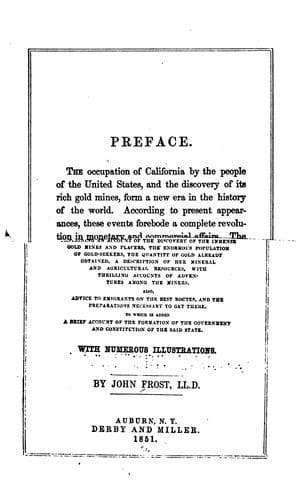
History of the State of California: From the Period of the Conquest by Spain to Her Occupation by the United States of AmericaFrost, John
History
History of the State of California: From the Period of the Conquest by Spain to Her Occupation by the United States of America
Frost, John
California -- Gold discoveries; California -- History
"The cold, dry currents of air from the north-east, after passing the
Rocky Mountains and the Sierra Nevada, descend to the Pacific, and
absorb the moisture of the atmosphere, to a great distance from the
land. The cold air from the mountains, and that which accompanies the
great ocean current from the north-west, thus become united; and vast
banks of fog are generated, which, when driven by the wind has a
penetrating, or _cutting_, effect on the human skin, much more
uncomfortable than would be felt in the humid atmosphere of the
Atlantic, at a much lower temperature.
"As the sun rises from day to day, week after week, and month after
month, in unclouded brightness during the dry season, and pours down
its unbroken rays on the dry, unprotected surface of the country, the
heat becomes so much greater inland than it is on the ocean, that an
under-current of cold air, bringing the fog with it, rushes over the
coast range of hills, and through their numerous passes, towards the
interior.
"Every day, as the heat, inland, attains a sufficient temperature, the
cold, dry wind from the ocean commences to blow. This is usually from
eleven to one o'clock: and, as the day advances, the wind increases
and continues to blow till late at night. When the vacuum is filled,
or the equilibrium of the atmosphere restored, the wind ceases; a
perfect calm prevails until about the same hour the following day,
when the same process commences and progresses as before; and these
phenomena are of daily occurrence, with few exceptions, throughout the
dry season.
"These cold winds and fogs render the climate at San Francisco, and
all along the coast of California, except the extreme southern portion
of it, probably more uncomfortable, to those not accustomed to it, in
summer than in winter.
"A few miles inland, where the heat of the sun modifies and softens
the wind from the ocean, the climate is moderate and delightful. The
heat, in the middle of the day, is not so great as to retard labor or
render exercise in the open air uncomfortable. The nights are cool and
pleasant. This description of climate prevails in all the valleys
along the coast range, and extends throughout the country, north and
south, as far eastward as the valley of the Sacramento and San
Joaquin. In this vast plain, the sea-breeze loses its influence, and
the degree of heat in the middle of the day, during the summer months,
is much greater than is known on the Atlantic coast in the same
latitudes. It is dry, however, and probably not more oppressive. On
the foot-hills of the Sierra Nevada, and especially in the deep
ravines of the streams, the thermometer frequently ranges from 110° to
115° in the shade, during three or four hours of the day, say from
eleven until three o'clock. In the evening, as the sun declines, the
radiation of heat ceases. The cool, dry atmosphere from the mountains
spreads over the whole country, and renders the nights cool and
invigorating.
Public-domain text, read in full here on John Shaqi.
Reviews
Reviews
No reviews yet
Be the first to share your thoughts on this work.
Elsewhere in the archive
Join the Discussion
Join the discussion
Sign in to leave a comment or review.
Sign InorCreate an account