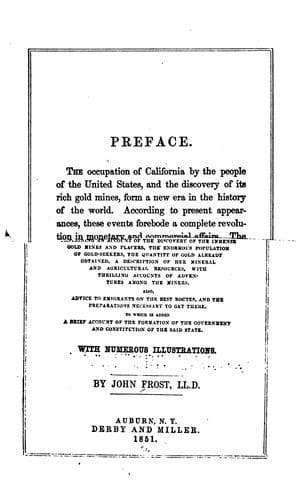
History of the State of California: From the Period of the Conquest by Spain to Her Occupation by the United States of AmericaFrost, John
History
History of the State of California: From the Period of the Conquest by Spain to Her Occupation by the United States of America
Frost, John
California -- Gold discoveries; California -- History
"The grasses are very luxuriant and nutritious, affording excellent
pasture. The oats, which spring up the whole length of the sea-coast,
and from forty to sixty miles inland, render the cultivation of that
crop entirely unnecessary, and yield a very great quantity of
nutritious food for horses, cattle, and sheep. The dry season matures,
and I may say cures, these grasses and oats, so that they remain in an
excellent state of preservation during the summer and autumn, and
afford an ample supply of forage. While the whole surface of the
country appears parched, and vegetation destroyed, the numerous flocks
and herds which roam over it continue in excellent condition.
"Although the mildness of the winter months, and the fertility of the
soil, secure to California very decided agricultural advantages, it is
admitted that _irrigation_ would be of very great importance, and
necessarily increase the products of the soil, in quantity and
variety, during the greater part of the dry season. It should,
therefore, be encouraged by government, in the survey and disposition
of the public lands, as far as practicable.
"The farmer derives some very important benefits from the dry season.
His crops in harvest time are never injured by rain; he can with
perfect confidence permit them to remain in his fields as long after
they have been gathered as his convenience may require; he has no
fears that they will be injured by wet or unfavorable weather. Hence
it is that many who have long been accustomed to that climate prefer
it to the changeable weather east of the Rocky Mountains.
"As already stated, the forests of California, south of latitude 39°,
and west of the foot-hills of the Sierra Nevada, are limited to
detached, scattering groves of oak in the valleys, and of red wood on
the ridges and on the gorges of the hills.
"It can be of no practical use to speculate on the causes which have
denuded so large an extent of country, further than to ascertain
whether the soil is or is not favorable to the growth of forest trees.
"When the dry season sets in, the entire surface is covered with a
luxuriant growth of grass and oats, which, as the summer advances,
become perfectly dry. The remains of all dead trees and shrubs also
become dry. These materials, therefore, are very combustible, and
usually take fire in the latter part of summer and beginning of
autumn, which commonly passes over the whole country, destroying, in
its course, the young shrubs and trees. In fact, it seems to be the
same process which has destroyed or prevented the growth of forest
trees on the prairies of the Western States, and not any quality in
the soil unfriendly to their growth.
"The absence of timber and the continuance of the dry season are apt
to be regarded by farmers, on first going into the country, as
irremediable defects, and as presenting obstacles, almost
insurmountable, to the successful progress of agriculture. A little
experience will modify these opinions.
Public-domain text, read in full here on John Shaqi.
Reviews
Reviews
No reviews yet
Be the first to share your thoughts on this work.
Elsewhere in the archive
Join the Discussion
Join the discussion
Sign in to leave a comment or review.
Sign InorCreate an account