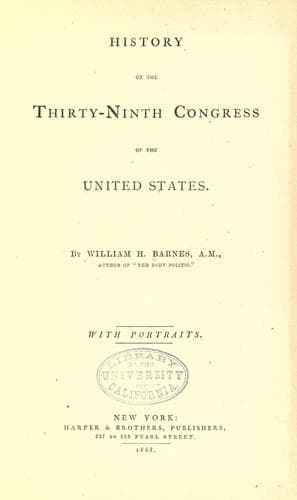
History of the Thirty-Ninth Congress of the United StatesBarnes, William Horatio
History
History of the Thirty-Ninth Congress of the United States
Barnes, William Horatio
United States -- Politics and government -- 1865-1869; United States. Congress (39th : 1865-1867)
NAYS--Messrs. Buckalew, Davis, Guthrie, Hendricks, Johnson,
McDougall, Riddle, Saulsbury, Stockton, and Wright--10.
ABSENT--Messrs. Cowan, Nesmith, and Willey--3.
The bill having passed, the question came up as to its title, which it
was proposed to leave as reported by the committee: "A bill to enlarge
the powers of the Freedmen's Bureau."
Mr. Davis moved to amend the title by substituting for it, "A bill to
appropriate a portion of the public land in some of the Southern
States and to authorize the United States Government to purchase lands
to supply farms and build houses upon them for the freed negroes; to
promote strife and conflict between the white and black races; and to
invest the Freedmen's Bureau with unconstitutional powers to aid and
assist the blacks, and to introduce military power to prevent the
commissioner and other officers of said bureau from being restrained
or held responsible in civil courts for their illegal acts in
rendering such aid and assistance to the blacks, and for other
purposes."
The President _pro tempore_ pronounced the amendment "not in order,
inconsistent with the character of the bill, derogatory to the Senate,
a reproach to its members."
Mr. McDougall declared the proposed amendment "an insult to the action
of the Senate."
The unfortunate proposition was quietly abandoned by its author, and
passed over without further notice by the Senate. By unanimous
consent, the title of the bill remained as first reported.
CHAPTER VII.
THE FREEDMEN'S BUREAU BILL IN THE HOUSE.
The Bill reported to the House -- Mr. Eliot's Speech --
History -- Mr. Dawson vs. the Negro -- Mr. Garfield -- The
Idol Broken -- Mr. Taylor counts the Cost -- Mr. Donnelly's
Amendment -- Mr. Kerr -- Mr. Marshall on White Slavery --
Mr. Hubbard -- Mr. Moulton -- Opposition from Kentucky --
Mr. Ritter -- Mr. Rousseau's Threat -- Mr. Shanklin's Gloomy
Prospect -- Mr. Trimble's Appeal -- Mr. Mckee an exceptional
Kentuckian -- Mr. Grinnell on Kentucky -- the Example of
Russia -- Mr. Phelps -- Mr. Shellabarger's Amendment -- Mr.
Chanler -- Mr. Stevens' Amendments -- Mr. Eliot closes the
Discussion -- Passage of the Bill -- Yeas and Nays.
On the day succeeding the passage of the bill in the Senate, it was
sent to the House of Representatives, and by them referred to the
Select Committee on the Freedmen.
On the 30th of January, Mr. Eliot, Chairman of this committee,
reported the bill to the House with amendments, mainly verbal
alterations.
Public-domain text, read in full here on John Shaqi.
Reviews
Reviews
No reviews yet
Be the first to share your thoughts on this work.
Elsewhere in the archive
Join the Discussion
Join the discussion
Sign in to leave a comment or review.
Sign InorCreate an account