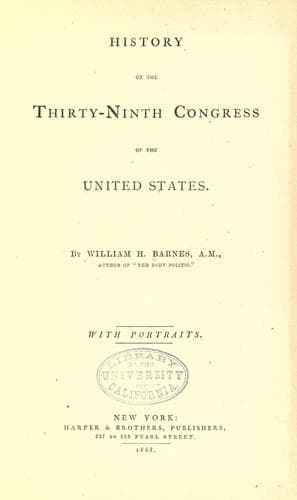
History of the Thirty-Ninth Congress of the United StatesBarnes, William Horatio
History
History of the Thirty-Ninth Congress of the United States
Barnes, William Horatio
United States -- Politics and government -- 1865-1869; United States. Congress (39th : 1865-1867)
In a speech, advocating the passage of the bill, Mr. Eliot presented
something of the history of legislation for the freedmen. He said: "On
the 3d day of last March the bill establishing a Freedmen's Bureau
became a law. It was novel legislation, without precedent in the
history of any nation, rendered necessary by the rebellion of eleven
slave States and the consequent liberation from slavery of four
million persons whose unpaid labor had enriched the lands and
impoverished the hearts of their relentless masters.
"At an early day, when the fortunes of war had shown alternate
triumphs and defeats to loyal arms, and the timid feared and the
disloyal hoped, it was my grateful office to introduce the first bill
creating a bureau of emancipation. It was during the Thirty-seventh
Congress. But, although the select committee to which the bill was
referred was induced to agree that it should be reported to the House,
it so happened that the distinguished Chairman, Judge White, of
Indiana, did not succeed in reporting it for our action. At the
beginning of the Thirty-eighth Congress it was again presented, and
very soon was reported back to the House under the title of 'A bill to
establish a Bureau of Freedmen's Affairs.' It was fully debated and
passed by the House. The vote was sixty-nine in favor, and sixty-seven
against the bill; but of the sixty-seven who opposed it, fifty-six had
been counted against it, because of their political affinities. On the
1st of March, 1864, the bill went to the Senate. It came back to the
House on the 30th of June, four days before the adjournment of
Congress. To my great regret, the Senate had passed an amendment in
the nature of a substitute, attaching this bureau to the Treasury
Department; but it was too late to take action upon it then, and the
bill was postponed until December. At that time the House
non-concurred with the Senate, and a committee of conference was
chosen. The managers of the two houses could not agree as to whether
the War Department or the Treasury should manage the affairs of the
bureau. They therefore agreed upon a bill creating an independent
department neither attached to the War nor Treasury, but communicating
directly with the President, and resting for its support upon the arm
of the War Department. That bill was also passed by the House but was
defeated in the Senate. Another Conference Committee was chosen, and
that committee, whose chairman in the House was the distinguished
gentleman from Ohio, then and now at the head of the Military
Committee, agreed upon a bill attaching the bureau to the War
Department, and embracing refugees as well as freedmen in its terms.
That bill is now the law.
Public-domain text, read in full here on John Shaqi.
Reviews
Reviews
No reviews yet
Be the first to share your thoughts on this work.
Elsewhere in the archive
Join the Discussion
Join the discussion
Sign in to leave a comment or review.
Sign InorCreate an account