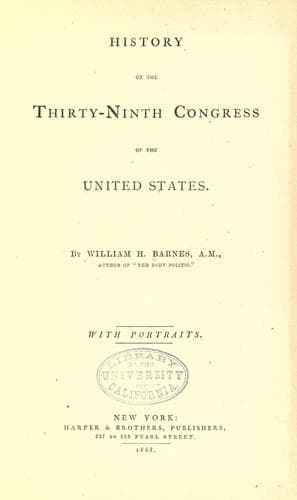
History of the Thirty-Ninth Congress of the United StatesBarnes, William Horatio
History
History of the Thirty-Ninth Congress of the United States
Barnes, William Horatio
United States -- Politics and government -- 1865-1869; United States. Congress (39th : 1865-1867)
"The commissioners were instructed to permit the freedmen to select
their own employers and to choose their own kind of service. All
agreements were ordered to be free and mutual, and not to be
compulsory. The old system that had prevailed of overseer labor was
ordered to be repudiated by the commissioners who had charge of the
laborers, and I believe there has been no time since the organization
of the bureau when there have not been reports made to head-quarters
at Washington of all labor contracts; and wherever any provisions had
been inserted, by inadvertence or otherwise, that seemed unjustly to
operate against the freedmen, they have been stricken out by direction
of the commissioner here.
"In the course of the next month, action was taken by the commissioner
respecting a provision of the law as it was passed in March,
authorizing the Secretary of War to make issues of clothing and
provisions, and the assistant commissioners were required carefully to
ascertain whatever might be needed under that provision of the law,
and to make periodical reports as to the demands made upon the
Government through the bureau. Directions were given by the
commissioner to his assistant commissioners to make repeated reports
to him upon all the various subjects which had come under his
charge--with regard to the number of freedmen, where they were,
whether in camps or in colonies, or whether they were employed upon
Government works, and stating, if they obtained supplies, how they
were furnished, whether by donations or whether procured by purchase.
Reports were also required as to all lands which had been put under
the care of the bureau; and statements were called for showing
descriptions of the lands, whether, in the language of the law,
'abandoned' or 'confiscated,' so that the bureau here could have full
and complete information of all action of its agents throughout these
States, and upon examination it could be determined where any specific
lands which were under the charge of the bureau came from, and how
they were derived.
"In the course of the summer, it became necessary to issue additional
instructions. The commissioner found that his way was beset with
difficulties; he was walking upon unknown ground; he was testing here
and there questions involved in doubt. It was hardly possible at once
and by one order to designate all that it would be needful for him to
do, and, therefore, different instructions were issued from time to
time from his office. The assistant commissioners were called upon
thoroughly to examine, either by themselves or their agents, the
respective districts allotted to them, to make inquiry as to the
character of the freedmen under their charge, their ability to labor,
their disposition to labor, and the circumstances under which they
were placed, so that the aid, the care, and the protection which the
law contemplated might be afforded to them as quickly and as
economically as possible.
Public-domain text, read in full here on John Shaqi.
Reviews
Reviews
No reviews yet
Be the first to share your thoughts on this work.
Elsewhere in the archive
Join the Discussion
Join the discussion
Sign in to leave a comment or review.
Sign InorCreate an account