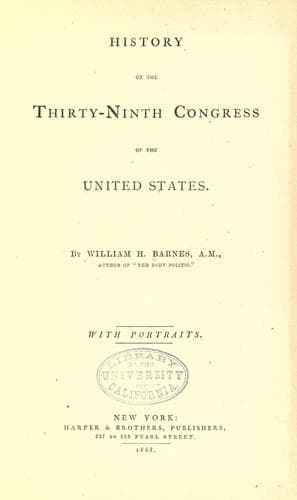
History of the Thirty-Ninth Congress of the United StatesBarnes, William Horatio
History
History of the Thirty-Ninth Congress of the United States
Barnes, William Horatio
United States -- Politics and government -- 1865-1869; United States. Congress (39th : 1865-1867)
"The law was approved on the 3d of March, 1865. Nine months have not
yet elapsed since its organization. The order from the War Department
under which the bureau was organized bears date on the 12th of May,
1865. General Howard, who was then in command of the Department of
Tennessee, was assigned as commissioner of the bureau. The bill became
a law so late in the session that it was impossible for Congress to
legislate any appropriation for its support. It was necessary,
therefore, that the management of it should be placed in the hands of
military officers, and fortunately the provisions of the bill
permitted that to be done. General Howard was, as I stated, in command
of the Department of Tennessee, when he was detailed to this duty. But
on the 15th of May, that is to say, within three days after the order
appointing him, was issued, he assumed the duties of his office.
"In the course of a few days, the commissioner of the bureau announced
more particularly the policy which he designed to pursue. The whole
supervision of the care of freedmen and of all lands which the law
placed under the charge of the bureau was to be intrusted to assistant
commissioners.
"Before a month had expired, head-quarters had been established for
assistant commissioners at Richmond, Raleigh, Beaufort, Montgomery,
Nashville, St. Louis, Vicksburg, New Orleans, and Jacksonville, and
very shortly afterward assistant commissioners were designated for
those posts of duty. They were required to possess themselves, as soon
as practicable, with the duties incident to their offices, to quicken
in every way they could and to direct the industry of the freedmen.
Notice was given that the relief establishments which had been created
by law under the operations of the War Department should be
discontinued as soon as they could be consistently with the comfort
and proper protection of the freedmen, and that every effort should be
made--and I call the attention of gentlemen to the fact that that
policy has been pursued throughout--that every effort should be made
to render the freedmen, at an early day, self-supporting. The supplies
that had been furnished by the Government were only to be continued so
long as the actual wants of the freedmen seemed to require it. At that
time there were all over the country refugees who were seeking their
homes, and they were notified that, under the care of the bureau, they
would be protected from abuse, and directed in their efforts to secure
transportation and proper facilities for reaching home.
"Wherever there had been interruption of civil law, it was found
impossible that the rights of freedmen could be asserted in the
courts; and where there were no courts before which their rights could
be brought for adjudication, military tribunals, provost-marshals'
courts, were established, for the purpose of determining upon
questions arising between freedmen or between freedmen and other
parties; and that, also, has been continued to this day.
Public-domain text, read in full here on John Shaqi.
Reviews
Reviews
No reviews yet
Be the first to share your thoughts on this work.
Elsewhere in the archive
Join the Discussion
Join the discussion
Sign in to leave a comment or review.
Sign InorCreate an account