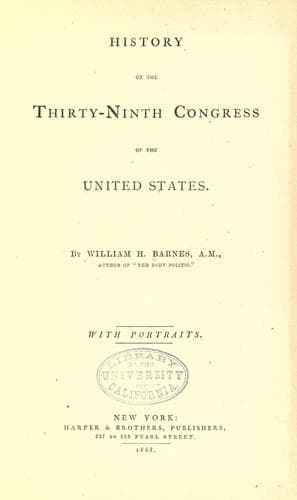
History of the Thirty-Ninth Congress of the United StatesBarnes, William Horatio
History
History of the Thirty-Ninth Congress of the United States
Barnes, William Horatio
United States -- Politics and government -- 1865-1869; United States. Congress (39th : 1865-1867)
Referring to the feeling manifested by Mr. Guthrie, Mr. Trumbull said:
" God forbid that I should put a degradation on the people of
Kentucky. I never thought of such a thing. I would sooner cut off my
right hand than do such a thing. What is it that so excites and
inflames the mind of the Senator from Kentucky that he talks about the
degradation that is to be put upon her, the plunder of her people, the
injustice that is to be done her inhabitants? Why, sir, a bill to help
the people of Kentucky to take care of the destitute negroes, made
free without any property whatever, without the means of support, left
to starve and to die unless somebody cares for them; and we propose in
the Congress of the United States to help to do it. Is that a
degradation? Is that an injustice? Is that the way to rob a people?"
Mr. McDougall having subsequently obtained the floor, made the remark:
"I, being a white man, say for the white men and white women that they
will take care of themselves. This bill was not made for white women
or white men, or white men and women's children."
This brought out the following statistical statement from Mr.
Trumbull: "I have before me the official report, which shows the
consolidated number of rations issued in the different districts and
States during the month of June, July, August, September, and October,
1865. In June there were issued to refugees three hundred and thirteen
thousand six hundred and twenty-seven rations, and thirty six thousand
one hundred and eighty-one to freedmen. In August, in Kentucky and
Tennessee, there were issued to refugees eighty-seven thousand one
hundred and eighty rations, and to freedmen eighty-seven thousand one
hundred and ninety-five--almost an equality."
Mr. Johnson, of Maryland remarked: "The object of the bill is a very
correct one; these people should be taken care of; and as it is
equally applicable to the whites and to the blacks, and the whites in
many of the States requiring as much protection as the blacks, I would
very willingly vote for the bill if I thought we had the power to pass
it; but on the question of power I have no disposition now or perhaps
at any time in the present stage of the bill to trouble the Senate."
The bill soon after passed the Senate as amended in the House, and
reaemended in the Senate, by a vote of twenty-nine to seven.
On the following day, the amendments of the Senate were concurred in
by the House without debate, and the Freedmen's Bureau Bill was ready
to be submitted to the Executive.
Ten day's after the final passage of the bill, the President sent to
the Senate a message, "with his objection thereto in writing."
The Senate immediately suspended other business to hear the VETO
MESSAGE, which was read by the Secretary, as follows:
"_To the Senate of the United States:_
Public-domain text, read in full here on John Shaqi.
Reviews
Reviews
No reviews yet
Be the first to share your thoughts on this work.
Elsewhere in the archive
Join the Discussion
Join the discussion
Sign in to leave a comment or review.
Sign InorCreate an account