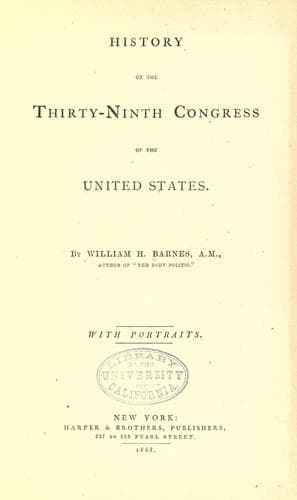
History of the Thirty-Ninth Congress of the United StatesBarnes, William Horatio
History
History of the Thirty-Ninth Congress of the United States
Barnes, William Horatio
United States -- Politics and government -- 1865-1869; United States. Congress (39th : 1865-1867)
"I have examined with care the bill which originated in the
Senate, and has been passed by the two houses of Congress,
to amend an act entitled 'An act to establish a Bureau for
the relief of Freedmen and Refugees,' and for other
purposes. Having, with much regret, come to the conclusion
that it would not be consistent with the public welfare to
give my approval to the measure, I return the bill to the
Senate with my objections to its becoming a law.
"I might call to mind, in advance of these objections, that
there is no immediate necessity for the proposed measure.
The act to establish a Bureau for the relief of Freedmen and
Refugees, which was approved in the month of March last, has
not yet expired. It was thought stringent and extensive
enough for the purpose in view in time of war. Before it
ceases to have effect, further experience may assist to
guide us to a wise conclusion as to the policy to be adopted
in time of peace.
"I share with Congress the strongest desire to secure to the
freedmen the full enjoyment of their freedom and property,
and their entire independence and equality in making
contracts for their labor; but the bill before me contains
provisions which, in my opinion, are not warranted by the
Constitution, and are not well suited to accomplish the end
in view.
"The bill proposes to establish by authority of Congress,
military jurisdiction over all parts of the United States
containing refugees and freedmen. It would, by its very
nature, apply with most force to those parts of the United
States in which the freedmen most abound; and it expressly
extends the existing temporary jurisdiction of the
Freedmen's Bureau, with greatly enlarged powers, over those
States 'in which the ordinary course of judicial proceeding,
has been interrupted by the rebellion.' The source from
which this military jurisdiction is to emanate is none other
than the President of the United States, acting through the
War Department and the commissioner of the Freedmen's
Bureau. The agents to carry out this military jurisdiction
are to be selected either from the army or from civil life;
the country is to be divided into districts and
sub-districts; and the number of salaried agents to be
employed may be equal to the number of counties or parishes
in all the United States where freedmen and refugees are to
be found.
Public-domain text, read in full here on John Shaqi.
Reviews
Reviews
No reviews yet
Be the first to share your thoughts on this work.
Elsewhere in the archive
Join the Discussion
Join the discussion
Sign in to leave a comment or review.
Sign InorCreate an account