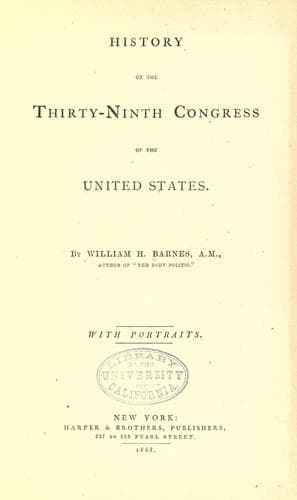
History of the Thirty-Ninth Congress of the United StatesBarnes, William Horatio
History
History of the Thirty-Ninth Congress of the United States
Barnes, William Horatio
United States -- Politics and government -- 1865-1869; United States. Congress (39th : 1865-1867)
"While the territory and the classes of actions and offenses
that are made subject to this measure are so extensive, the
bill itself, should it become a law, will have no limitation
in point of time, but will form a part of the permanent
legislation of the country. I can not reconcile a system of
military jurisdiction of this kind with the words of the
Constitution, which declare that 'no person shall be held to
answer for a capital or otherwise infamous crime unless upon
a presentment or indictment of a grand jury, except in cases
arising in the land and naval forces, or in the militia when
in actual service in time of war or public danger;' and that
'in all criminal prosecutions the accused shall enjoy the
right to a speedy and public trial, by an impartial jury of
the State or district wherein the crime shall have been
committed.' The safeguards which the experience and wisdom
of ages taught our fathers to establish as securities for
the protection of the innocent, the punishment of the
guilty, and the equal administration of justice, are to be
set aside, and for the sake of a more vigorous interposition
in behalf of justice, we are to take the risk of the many
acts of injustice that would necessarily follow from an
almost countless number of agents established in every
parish or county in nearly a third of the States of the
Union, over whose decisions there is to be no supervision or
control by the Federal courts. The power that would be thus
placed in the hands of the President is such as in time of
peace certainly ought never to be intrusted to any one man.
"If it be asked whether the creation of such a tribunal
within a State is warranted as a measure of war, the
question immediately presents itself whether we are still
engaged in war. Let us not unnecessarily disturb the
commerce and credit and industry of the country by declaring
to the American people and to the world, that the United
States are still in a condition of civil war. At present
there is no part of our country in which the authority of
the United States is disputed. Offenses that may be
committed by individuals should not work a forfeiture of the
rights of whole communities. The country has returned, or is
returning, to a state of peace and industry, and the
rebellion is in fact at an end. The measure, therefore,
seems to be as inconsistent with the actual condition of the
country as it is at variance with the Constitution of the
United States.
"If, passing from general considerations, we examine the
bill in detail, it is open to weighty objections.
Public-domain text, read in full here on John Shaqi.
Reviews
Reviews
No reviews yet
Be the first to share your thoughts on this work.
Elsewhere in the archive
Join the Discussion
Join the discussion
Sign in to leave a comment or review.
Sign InorCreate an account