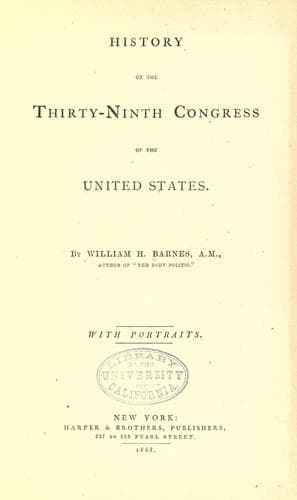
History of the Thirty-Ninth Congress of the United StatesBarnes, William Horatio
History
History of the Thirty-Ninth Congress of the United States
Barnes, William Horatio
United States -- Politics and government -- 1865-1869; United States. Congress (39th : 1865-1867)
"The subjects over which this military jurisdiction is to
extend in every part of the United States include protection
to 'all employes, agents, and officers of this bureau in the
exercise of the duties imposed' upon them by the bill. In
eleven States it is further to extend over all cases
affecting freedmen and refugees discriminated against' by
local law, custom, or prejudice.' In those eleven States the
bill subjects any white person who may be charged with
depriving a freedman of 'any civil rights or immunities
belonging to white persons' to imprisonment or fine, or
both, without, however, defining the 'civil rights and
immunities' which are thus to be secured to the freedmen by
military law. This military jurisdiction also extends to all
questions that may arise respecting contracts. The agent who
is thus to exercise the office of a military judge may be a
stranger, entirely ignorant of the laws of the place, and
exposed to the errors of judgment to which all men are
liable. The exercise of power, over which there is no legal
supervision, by so vast a number of agents as is
contemplated by the bill, must, by the very nature of man,
be attended by acts of caprice, injustice, and passion.
"The trials, having their origin under this bill, are to
take place without the intervention of a jury, and without
any fixed rules of law or evidence. The rules on which
offenses are to be 'heard and determined' by the numerous
agents, are such rules and regulations as the President,
through the War Department, shall prescribe. No previous
presentment is required, nor any indictment charging the
commission of a crime against the laws; but the trial must
proceed on charges and specifications. The punishment will
be, not what the law declares, but such as a court-martial
may think proper; and from these arbitrary tribunals there
lies no appeal, no writ of error to any of the courts in
which the Constitution of the United States vests
exclusively the judicial power of the country.
Public-domain text, read in full here on John Shaqi.
Reviews
Reviews
No reviews yet
Be the first to share your thoughts on this work.
Elsewhere in the archive
Join the Discussion
Join the discussion
Sign in to leave a comment or review.
Sign InorCreate an account