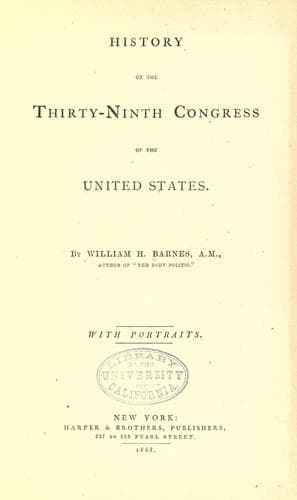
History of the Thirty-Ninth Congress of the United StatesBarnes, William Horatio
History
History of the Thirty-Ninth Congress of the United States
Barnes, William Horatio
United States -- Politics and government -- 1865-1869; United States. Congress (39th : 1865-1867)
"The appointment of an agent for every county and parish
will create an immense patronage; and the expense of the
numerous officers and their clerks, to be appointed by the
President, will be great in the beginning, with a tendency
steadily to increase. The appropriations asked by the
Freedmen's Bureau, as now established, for the year 1866,
amount to $11,745,000. It may be safely estimated that the
cost to be incurred under the pending bill will require
double that amount--more than the entire sum expended in any
one year under the administration of the second Adams. If
the presence of agents in every parish and county is to be
considered as a war measure, opposition, or even resistance,
might be provoked, so that, to give effect to their
jurisdiction, troops would have to be stationed within reach
of every one of them, and thus a large standing force be
rendered necessary. Large appropriations would therefore be
re-required to sustain and enforce military jurisdiction in
every county or parish from the Potomac to the Rio Grande.
The condition of our fiscal affairs is encouraging, but, in
order to sustain the present measure of public confidence,
it is necessary that we practice not merely customary
economy, but, as far as possible, severe retrenchment.
"In addition to the objections already stated, the fifth
section of the bill proposes to take away land from its
former owners without any legal proceedings being first had,
contrary to that provision of the Constitution which
declares that no person shall 'be deprived of life, liberty,
or property, without due process of law.' It does not appear
that a part of the lands to which this section refers may
not be owned by minors or persons of unsound mind, or by
those who have been faithful to all their obligations as
citizens of the United States. If any portion of the land is
held by such persons, it is not competent for any authority
to deprive them of it. If, on the other hand, it be found
that the property is liable to confiscation, even then it
can not be appropriated to public purposes until, by due
process of law, it shall have been declared forfeited to the
Government.
"There is still further objection to the bill on grounds
seriously affecting the class of persons to whom it is
designed to bring relief; it will tend to keep the mind of
the freedman in a state of uncertain expectation and
restlessness, while to those among whom he lives it will be
a source of constant and vague apprehension.
Public-domain text, read in full here on John Shaqi.
Reviews
Reviews
No reviews yet
Be the first to share your thoughts on this work.
Elsewhere in the archive
Join the Discussion
Join the discussion
Sign in to leave a comment or review.
Sign InorCreate an account