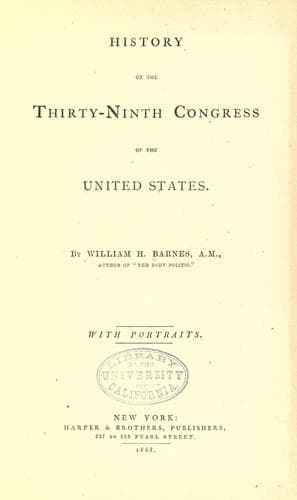
History of the Thirty-Ninth Congress of the United StatesBarnes, William Horatio
History
History of the Thirty-Ninth Congress of the United States
Barnes, William Horatio
United States -- Politics and government -- 1865-1869; United States. Congress (39th : 1865-1867)
"Undoubtedly the freedman should be protected, but he should
be protected by the civil authorities, especially by the
exercise of all the constitutional powers of the courts of
the United States and of the States. His condition is not so
exposed as may at first be imagined. He is in a portion of
the country where his labor can not well be spared.
Competition for his services from planters, from those who
are constructing or repairing railroads, and from
capitalists in his vicinage or from other States, will
enable him to command almost his own terms. He also
possesses a perfect right to change his place of abode; and
if, therefore, he does not find in one community or State a
mode of life suited to his desires, or proper remuneration
for his labor, he can move to another, where that labor is
more esteemed and better rewarded. In truth, however, each
State, induced by its own wants and interests, will do what
is necessary and proper to retain within its borders all the
labor that is needed for the development of its resources.
The laws that regulate supply and demand will maintain their
force, and the wages of the laborer will be regulated
thereby. There is no danger that the exceedingly great
demand for labor will not operate in favor of the laborer.
"Neither is sufficient consideration given to the ability of
the freedmen to protect and take care of themselves. It is
no more than justice to them to believe that, as they have
received their freedom with moderation and forbearance, so
they will distinguish themselves by their industry and
thrifty and soon show the world that, in a condition of
freedom, they are self-sustaining, capable of selecting
their own employment and their own places of abode, of
insisting for themselves on a proper remuneration, and of
establishing and maintaining their own asylums and schools.
It is earnestly hoped that, instead of wasting away, they
will, by their own efforts, establish for themselves a
condition of respect, ability, and prosperity. It is certain
that they can attain to that condition only through their
own merits and exertions.
"In this connection the query presents itself, whether the
system proposed by the bill will not, when put into complete
operation, practically transfer the entire care, support,
and control of four million emancipated slaves to agents,
overseers, or taskmasters, who, appointed at Washington, are
to be located in every county and parish throughout the
United States containing freedmen and refugees? Such a
system would inevitably tend to a concentration of power in
the Executive which would enable him, if so disposed, to
control the action of this numerous class and use them for
the attainment of his own political ends.
Public-domain text, read in full here on John Shaqi.
Reviews
Reviews
No reviews yet
Be the first to share your thoughts on this work.
Elsewhere in the archive
Join the Discussion
Join the discussion
Sign in to leave a comment or review.
Sign InorCreate an account