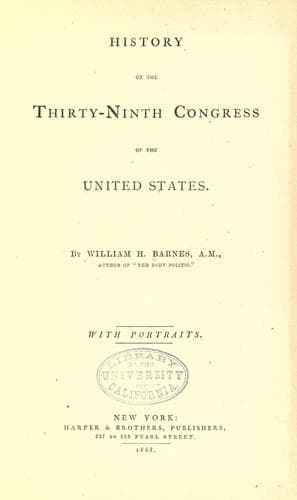
History of the Thirty-Ninth Congress of the United StatesBarnes, William Horatio
History
History of the Thirty-Ninth Congress of the United States
Barnes, William Horatio
United States -- Politics and government -- 1865-1869; United States. Congress (39th : 1865-1867)
"Great burdens have now to be borne by all the country, and
we may best demand that they shall be borne without murmur
when they are voted by a majority of the Representatives of
all the people. I would not interfere with the
unquestionable right of Congress to judge, each house for
itself, 'of the elections, returns, and qualifications of
its own members,' but that authority can not be construed as
including the right to shut out, in time of peace, any State
from the representation to which it is entitled by the
Constitution. At present, all the people of eleven States
are excluded--those who were most faithful during the war
not less than others. The State of Tennessee, for instance,
whose authorities engaged in rebellion, was restored to all
her constitutional relations to the Union by the patriotism
and energy of her injured and betrayed people. Before the
war was brought to a termination, they had placed themselves
in relation with the General Government, had established a
State government of their own; as they were not included in
the Emancipation Proclamation, they, by their own act, had
amended their Constitution so as to abolish slavery within
the limits of their State. I know no reason why the State of
Tennessee, for example, should not fully enjoy 'all her
constitutional relations to the United States.'
"The President of the United States stands toward the
country in a somewhat different attitude from that of any
member of Congress. Each member of Congress is chosen from a
single district or State; the President is chosen by the
people of all the States. As eleven are not at this time
represented in either branch of Congress, it would seem to
be his duty, on all proper occasions, to present their just
claims to Congress. There always will be differences of
opinion in the community, and individuals may be guilty of
transgressions of the law; but these do not constitute valid
objections against the right of a State to representation. I
would in nowise interfere with the discretion of Congress
with regard to the qualifications of members; but I hold it
my duty to recommend to you, in the interests of peace and,
in the interests of union, the admission of every State to
its share in public legislation when, however insubordinate,
insurgent, or rebellious its people may have been, it
presents itself, not only in an attitude of loyalty and
harmony, but in the persons of Representatives whose loyalty
can not be questioned under any existing constitutional or
legal test.
Public-domain text, read in full here on John Shaqi.
Reviews
Reviews
No reviews yet
Be the first to share your thoughts on this work.
Elsewhere in the archive
Join the Discussion
Join the discussion
Sign in to leave a comment or review.
Sign InorCreate an account