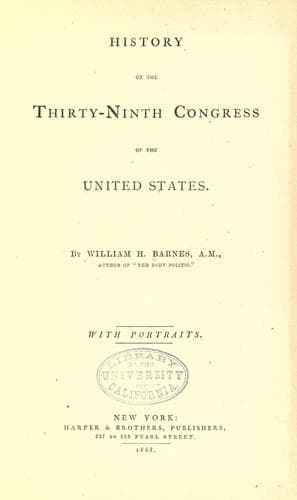
History of the Thirty-Ninth Congress of the United StatesBarnes, William Horatio
History
History of the Thirty-Ninth Congress of the United States
Barnes, William Horatio
United States -- Politics and government -- 1865-1869; United States. Congress (39th : 1865-1867)
"I can not but add another very grave objection to this
bill: The Constitution imperatively declares, in connection
with taxation, that each State shall have at least one
Representative, and fixes the rule for the number to which,
in future times, each State shall be entitled. It also
provides that the Senate of the United States shall be
composed of two Senators from each State, and adds, with
peculiar force, 'that no State, without its consent, shall
be deprived of its equal suffrage in the Senate.'. The
original act was necessarily passed in the absence of the
States chiefly to be affected, because their people were
then contumaciously engaged in the rebellion. Now the case
is changed, and some, at least, of those States are
attending Congress by loyal Representatives, soliciting the
allowance of the constitutional right of representation. At
the time, however, of the consideration and the passing of
this bill, there was no Senator or Representative in
Congress from the eleven States which are to be mainly
affected by its provisions. The very fact that reports were
and are made against the good disposition of the people of
that portion of the country is an additional reason why they
need, and should have, Representatives of their own in
Congress to explain their condition, reply to accusations,
and assist, by their local knowledge, in the perfecting of
measures immediately affecting themselves. While the liberty
of deliberation would then be free, and Congress would have
full power to decide according to its judgment, there could
be no objection urged that the States most interested had
not been permitted to be heard. The principle is firmly
fixed in the minds of the American people that there should
be no taxation without representation.
Public-domain text, read in full here on John Shaqi.
Reviews
Reviews
No reviews yet
Be the first to share your thoughts on this work.
Elsewhere in the archive
Join the Discussion
Join the discussion
Sign in to leave a comment or review.
Sign InorCreate an account