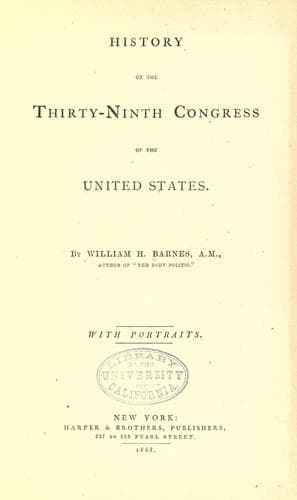
History of the Thirty-Ninth Congress of the United StatesBarnes, William Horatio
History
History of the Thirty-Ninth Congress of the United States
Barnes, William Horatio
United States -- Politics and government -- 1865-1869; United States. Congress (39th : 1865-1867)
The majority of the Senate was in favor of proceeding immediately to
the consideration of the message, and to have a vote as to whether the
bill should be passed, "the objections of the President to the
contrary notwithstanding." To this Mr. Lane, of Kansas, was opposed.
He said: "There are several Senators absent, and I think it but just
to them that they should have an opportunity to be present when the
vote is taken on this bill. I can not consent, so long as I can
postpone this question by the rules of the Senate, to have a vote upon
it to-night." Mr. Lane accordingly made four successive motions to
adjourn, in each of which he called for the yeas and nays. Finally,
the motion for adjournment having been made for the fifth time, it was
carried, with the understanding that the bill should be the pending
question at one o'clock on the following day.
On that day, February 20th, the bill and the message came duly before
the Senate. Mr. Davis obtained the floor, and made a long speech in
opposition to the bill and in favor of the Veto Message. He expressed
his aversion to the bill, and the objects sought to be attained under
it in very emphatic terms, but added nothing to the arguments which
had already been adduced.
Mr. Trumbull replied to the objections urged against the bill in the
President's Message. The President said, "The bill, should it become a
law will have no limitation in point of time, but will form a part of
the permanent legislation of the country."
"The object of the bill," replied Mr. Trumbull, "was to continue in
existence the Freedmen's Bureau--not as a permanent institution. Any
such intent was disavowed during the discussion of the bill. It is
true, no time is expressly limited in the bill itself when it shall
cease to operate, nor is it customary to insert such a clause in a
law; but it is declared that the bill shall operate until otherwise
provided by law. It is known that the Congress of the United States
assembles every year, and no one supposed that this bill was to
establish a bureau to be ingrafted upon the country as a permanent
institution; far from it. Nor is it a bill that is intended to go into
the States and take control of the domestic affairs of the States."
"There is no immediate necessity for the proposed measure," said the
President; "the act to establish a Bureau for the Relief of Freedmen
and Refugees, which was approved in the month of March last, has not
yet expired. It was thought stringent and extensive enough for the
purpose in view in time of war."
Public-domain text, read in full here on John Shaqi.
Reviews
Reviews
No reviews yet
Be the first to share your thoughts on this work.
Elsewhere in the archive
Join the Discussion
Join the discussion
Sign in to leave a comment or review.
Sign InorCreate an account