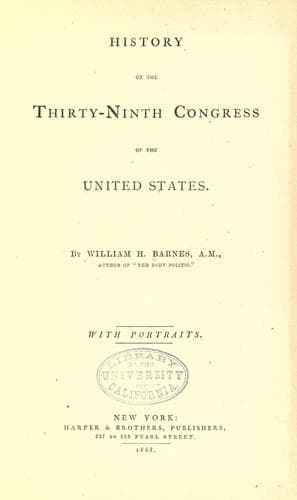
History of the Thirty-Ninth Congress of the United StatesBarnes, William Horatio
History
History of the Thirty-Ninth Congress of the United States
Barnes, William Horatio
United States -- Politics and government -- 1865-1869; United States. Congress (39th : 1865-1867)
"Is not this a different thing from taking away land from any body? Do
you take a thing away from another person when you have it in your
possession already? This fifth section, so far from taking land from
any body, provides simply for protecting the occupants of the land for
three years from the 16th of January, 1865, a little less than two
years from this time. If the section does any thing, it simply
prevents the restoration of this property to its former owners within
that period, except upon terms to be entered into, satisfactory to the
commissioner, between the occupant and the former owner. This is all
there is of it. It is a very different thing from taking away land
from its former owners."
"Undoubtedly," said the President, "the freedmen should be protected
by the civil authorities, especially by the exercise of all the
constitutional powers of the courts of the United States and of the
States."
"Let us see," replied Mr. Trumbull, "how they are protected by the
civil authority." After having read from documents setting forth laws
in reference to freedmen in force in Texas and Mississippi, Mr.
Trumbull continued: "I have here a number of communications of a
similar character, showing that, by the laws in some of the Southern
States, a pass system still exists, and that the negro really has no
protection afforded him either by the civil authorities or judicial
tribunals of the State. I have letters showing the same thing in the
State of Maryland, from persons whose character is vouched for as
reliable. Under this state of things, the President tells us that the
freedman should be protected 'by the exercise of all the
constitutional powers of the courts of the United States and of the
States!'"
"He also possesses," said the President, referring to the freedman, "a
perfect right to change his place of abode; and if, therefore, he does
not find in one community or State a mode of life suited to his
desires, or proper remuneration for his labor, he can move to another
where that labor is more esteemed and better rewarded."
Public-domain text, read in full here on John Shaqi.
Reviews
Reviews
No reviews yet
Be the first to share your thoughts on this work.
Elsewhere in the archive
Join the Discussion
Join the discussion
Sign in to leave a comment or review.
Sign InorCreate an account