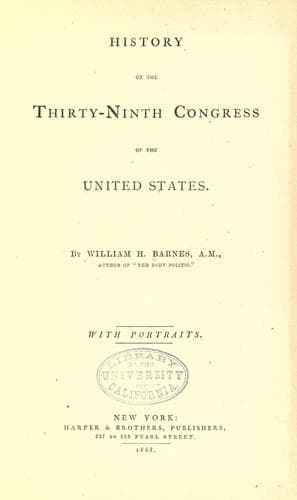
History of the Thirty-Ninth Congress of the United StatesBarnes, William Horatio
History
History of the Thirty-Ninth Congress of the United States
Barnes, William Horatio
United States -- Politics and government -- 1865-1869; United States. Congress (39th : 1865-1867)
"Then, sir," said Mr. Trumbull, "is there no necessity for some
supervising care of these people? Are they to be coldly told that they
have a perfect right to change their place of abode, when, if they are
caught in a strange neighborhood without a pass, they are liable to be
whipped? when combinations exist against them that they shall not be
permitted to hire unless to their former master? Are these people,
knowing nothing of geography, knowing not where to go, having never in
their lives been ten miles from the place where they were born, these
old women and young children, these feeble persons who are turned off
because they can no longer work, to be told to go and seek employment
elsewhere? and is the Government of the United States, which has made
them free, to stand by and do nothing to save and protect them? Are
they to be left to the mercy of such legislation as that of
Mississippi, to such laws as exist in Texas, to such practices as are
tolerated in Maryland and in Kentucky? Sir, I think some protection is
necessary for them, and that was the object of this bureau. It was not
intended, and such is not its effect, to interfere with the ordinary
administration of justice in any State, not even during the rebellion.
The moment that any State does justice and abolishes all
discrimination between whites and blacks in civil rights, the judicial
functions of the Freedmen's Bureau cease.
"But," continued Mr. Trumbull, "the President, most strangely of all,
dwells upon the unconstitutionality of this act, without ever having
alluded to that provision of the Constitution which its advocates
claim gives the authority to pass it. Is it not most extraordinary
that the President of the United States returns a bill which has
passed Congress, with his objections to it, alleging it to be
unconstitutional, and makes no allusion whatever in his whole message
to that provision of the Constitution which, in the opinion of its
supporters, clearly gives the authority to pass it? And what is that?
The second clause of the constitutional amendment, which declares that
Congress shall have authority by appropriate legislation to enforce
the article, which declares that there shall be neither slavery nor
involuntary servitude throughout the United States. If legislation be
necessary to protect the former slaves against State laws, which allow
them to be whipped if found away from home without a pass, has not
Congress, under the second clause of the amendment, authority to
provide it? What kind of freedom is that which the Constitution of the
United States guarantees to a man that does not protect him from the
lash if he is caught away from home without a pass? And how can we sit
here and discharge the constitutional obligation that is upon us to
pass the appropriate legislation to protect every man in the land in
his freedom, when we know such laws are being passed in the South, if
we do nothing to prevent their enforcement? Sir, so far from the bill
Public-domain text, read in full here on John Shaqi.
Reviews
Reviews
No reviews yet
Be the first to share your thoughts on this work.
Elsewhere in the archive
Join the Discussion
Join the discussion
Sign in to leave a comment or review.
Sign InorCreate an account