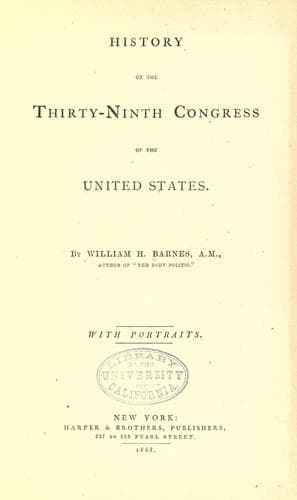
History of the Thirty-Ninth Congress of the United StatesBarnes, William Horatio
History
History of the Thirty-Ninth Congress of the United States
Barnes, William Horatio
United States -- Politics and government -- 1865-1869; United States. Congress (39th : 1865-1867)
The President said: "The President of the United States stands toward
the country in a somewhat different attitude from that of any member
of Congress. Each member of Congress is chosen from a single district
or State; the President is chosen by the people of all the States. As
eleven States are not at this time represented in either branch of
Congress, it would seem to be his duty, on all proper occasions, to
present their just claims to Congress."
"If it would not be disrespectful," said Mr. Trumbull, "I should like
to inquire how many votes the President got in those eleven States.
Sir, he is no more the representative of those eleven States than I
am, except as he holds a higher position. I came here as a
Representative chosen by the State of Illinois; but I came here to
legislate, not simply for the State of Illinois, but for the United
States of America, and for South Carolina as well as Illinois. I deny
that we are simply the Representatives of the districts and States
which send us here, or that we are governed by such narrow views that
we can not legislate for the whole country; and we are as much the
Representatives, and, in this particular instance, receive as much of
the support of those eleven States as did the President himself."
Mr. Trumbull finally remarked: "The President believes this bill
unconstitutional; I believe it constitutional. He believes that it
will involve great expense; I believe it will save expense. He
believes that the freedmen will be protected without it; I believe he
will be tyrannized over, abused, and virtually reenslaved, without
some legislation by the nation for his protection. He believes it
unwise; I believe it to be politic."
Without further debate, the vote was taken on the question, "Shall the
bill pass, the objections of the President of the United States
notwithstanding?" The Senators voted as follows:
YEAS--Messrs. Anthony, Brown, Chandler, Clark, Conness,
Cragin, Creswell, Fessenden, Foster, Grimes, Harris,
Henderson, Howard, Howe, Kirkwood, Lane of Indiana, Lane of
Kansas, Morrill, Nye, Poland, Pomeroy, Ramsey, Sherman,
Sprague, Sumner, Trumbull, Wade, Williams, Wilson, and
Yates--30.
NAYS--Messrs. Buckalew, Cowan, Davis, Dixon, Doolittle,
Guthrie, Hendricks, Johnson, McDougall, Morgan, Nesmith,
Norton, Riddle, Saulsbury, Stewart, Stockton, Van Winkle,
and Willey--18.
ABSENT--Messrs. Foot and Wright--2.
The President _pro tempore_ then announced, "On this question the yeas
are thirty and the nays are eighteen. Two-thirds of the members
present not having voted for the bill, it is not a law."
CHAPTER IX.
THE CIVIL RIGHTS BILL IN THE SENATE.
Public-domain text, read in full here on John Shaqi.
Reviews
Reviews
No reviews yet
Be the first to share your thoughts on this work.
Elsewhere in the archive
Join the Discussion
Join the discussion
Sign in to leave a comment or review.
Sign InorCreate an account