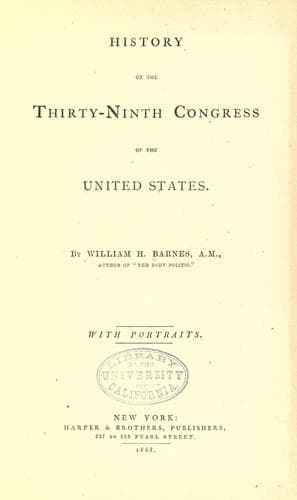
History of the Thirty-Ninth Congress of the United StatesBarnes, William Horatio
History
History of the Thirty-Ninth Congress of the United States
Barnes, William Horatio
United States -- Politics and government -- 1865-1869; United States. Congress (39th : 1865-1867)
being unconstitutional, I should feel that I had failed in my
constitutional duty if I did not propose some measure that would
protect these people in their freedom. And yet this clause of the
Constitution seems to have escaped entirely the observation of the
President.
"The President objects to this bill because it was passed in the
absence of representation from the rebellious States. If that
objection be valid, all our legislation affecting those States is
wrong, and has been wrong from the beginning. When the rebellion broke
out, in the first year of the war, we passed a law for collecting a
direct tax, and we assessed that tax upon all the rebellious States.
According to the theory of the President, that was all wrong, because
taxation and representation did not go together. Those States were not
represented. Then, according to this argument, (I will not read all of
it,) we were bound to have received their Representatives, or else not
legislate for and tax them. He insists they were States in the Union
all the time, and according to the Constitution, each State is
entitled to at least one Representative.
"If the argument that Congress can not legislate for States
unrepresented is good now, it was good during the conflict of arms,
for none of the States whose governments were usurped are yet relieved
from military control. If we have no right to legislate for those
States now, we had no right to impose the direct tax upon them. We had
no right to pass any of our laws that affected them. We had no right
to raise an army to march into the rebellious States while they were
not represented in the Congress of the United States. We had no right
to pass a law declaring these States in rebellion. Why? The rebels
were not here to be represented in the American Senate. We had no
right to pass a law authorizing the President to issue a proclamation
discontinuing all intercourse with the people of those rebellious
States; and why? Because they were not represented here. We had no
right to blockade their coast. Why? They were not represented here.
They are States, says the President, and each State is entitled to two
Senators, and to at least one Representative. Suppose the State of
South Carolina had sent to Congress, during the war, a Representative;
had Congress nothing to do but to admit him, if found qualified? Must
he be received because he comes from a State, and a State can not go
out of the Union? Why, sir, is any thing more necessary than to state
this proposition to show its absolute absurdity?"
Public-domain text, read in full here on John Shaqi.
Reviews
Reviews
No reviews yet
Be the first to share your thoughts on this work.
Elsewhere in the archive
Join the Discussion
Join the discussion
Sign in to leave a comment or review.
Sign InorCreate an account