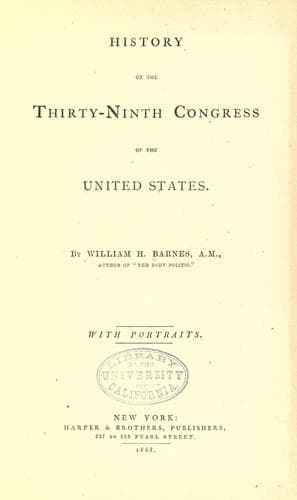
History of the Thirty-Ninth Congress of the United StatesBarnes, William Horatio
History
History of the Thirty-Ninth Congress of the United States
Barnes, William Horatio
United States -- Politics and government -- 1865-1869; United States. Congress (39th : 1865-1867)
"It is the intention of this bill to secure those rights. The laws in
the slaveholding States have made a distinction against persons of
African descent on account of their color, whether free or slave. I
have before me the statutes of Mississippi. They provide that if any
colored person, any free negro or mulatto, shall come into that State
for the purpose of residing there, he shall be sold into slavery for
life. If any person of African descent residing in that State travels
from one county to another without having a pass or a certificate of
his freedom, he is liable to be committed to jail, and to be dealt
with as a person who is in the State without authority. Other
provisions of the statute prohibit any negro or mulatto from having
firearms; and one provision of the statute declares that for
'exercising the functions of a minister of the Gospel, free negroes
and mulattoes, on conviction, may be punished by any number of lashes
not exceeding thirty-nine, on the bare back, and shall pay the costs."
Other provisions of the statute of Mississippi prohibit a free negro
or mulatto from keeping a house of entertainment, and subject him to
trial before two justices of the peace and five slaveholders for
violating the provisions of this law. The statutes of South Carolina
make it a highly penal offense for any person, white or colored, to
teach slaves; and similar provisions are to be found running through
all the statutes of the late slaveholding States.
"When the constitutional amendment was adopted and slavery abolished,
all these statutes became null and void, because they were all passed
in aid of slavery, for the purpose of maintaining and supporting it.
Since the abolition of slavery, the Legislatures which have assembled
in the insurrectionary States have passed laws relating to the
freedmen, and in nearly all the States they have discriminated against
them. They deny them certain rights, subject them to severe penalties,
and still impose upon them the very restrictions which were imposed
upon them in consequence of the existence of slavery, and before it
was abolished. The purpose of the bill under consideration is to
destroy all these discriminations, and to carry into effect the
constitutional amendment."
Public-domain text, read in full here on John Shaqi.
Reviews
Reviews
No reviews yet
Be the first to share your thoughts on this work.
Elsewhere in the archive
Join the Discussion
Join the discussion
Sign in to leave a comment or review.
Sign InorCreate an account