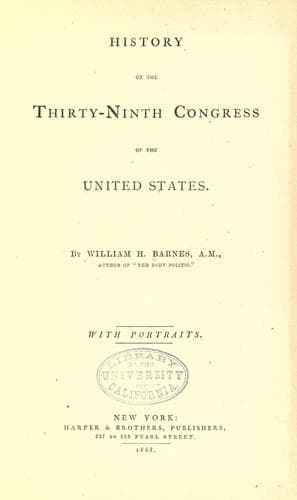
History of the Thirty-Ninth Congress of the United StatesBarnes, William Horatio
History
History of the Thirty-Ninth Congress of the United States
Barnes, William Horatio
United States -- Politics and government -- 1865-1869; United States. Congress (39th : 1865-1867)
"I suppose it is a foregone conclusion that this measure, as one of a
series of measures, is to be passed through this Congress regardless
of all consequences. But the day that the President of the United
States places his approval and signature to that Freedmen's Bureau
Bill, and to this bill, he will have signed two acts more dangerous to
the liberty of his countrymen, more disastrous to the citizens of this
country, than all the acts which have been passed from the foundation
of the Government to the present hour; and if we on this side of the
chamber manifest anxiety and interest in reference to these bills, and
the questions involved in them, it is because, having known this
population all our lives, knowing them in one hour of our infancy
better than you gentlemen have known them all your lives, we feel
compelled, by a sense of duty, earnestly and importunately, it may be,
to appeal to the judgment of the American Senate, and to reach, if
possible, the judgment of the great mass of the American people, and
invoke their attention to the awful consequences involved in measures
of this character. Sir, stop, stop! the mangled, bleeding body of the
Constitution of your country lies in your path; you are treading upon
its bleeding body when you pass these laws."
After having argued at considerable length that this bill would be a
most unconstitutional interference on the part of the Federal
Government with "the powers of the States under the Federal
Constitution," the Senator from Delaware thus concluded:
"Sir, from early boyhood I was taught to love and revere the Federal
Union and those who made it. In early childhood I read the words of
the Father of his country, in which he exhorted the people to cling to
the union of these States as the palladium of liberty, and my young
heart bounded with joy in reading the burning words of lofty
patriotism. I was taught in infancy to admire, as far as the infant
mind could admire, our free system of government, Federal and State;
and I heard the old men say that the wit of man never devised a better
or more lovely system of government. When I arrived at that age when I
could study and reflect for myself, the teachings of childhood were
approved by the judgment of the man.
Public-domain text, read in full here on John Shaqi.
Reviews
Reviews
No reviews yet
Be the first to share your thoughts on this work.
Elsewhere in the archive
Join the Discussion
Join the discussion
Sign in to leave a comment or review.
Sign InorCreate an account