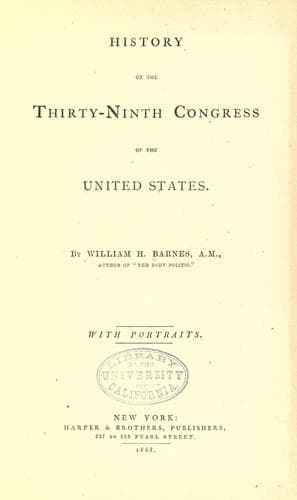
History of the Thirty-Ninth Congress of the United StatesBarnes, William Horatio
History
History of the Thirty-Ninth Congress of the United States
Barnes, William Horatio
United States -- Politics and government -- 1865-1869; United States. Congress (39th : 1865-1867)
"We hear a great deal about the sentence from the Declaration of
Independence, that 'all men are created equal.' I am willing to admit
that all men are created equal; but how are they equal? Can a citizen
of France, for instance, by going into England, be entitled to all the
rights of a citizen of that country, or by coming into this country
acquire all the rights of an American, unless he is naturalized? Can a
citizen of our country, by going into any other, become entitled to
the rights of a citizen there? If not, it may be said that they are
not equal. I believe that the division of men into separate
communities, and their living in society and association with their
fellows, as they do, are both divine institutions, and that,
consequently, the authors of the Declaration of Independence could
have meant nothing more than that the rights of citizens of any
community are equal to the rights of all other citizens of that
community. Whenever all communities are conducted in accordance with
these principles, these very conditions of their prosperous existence,
then all mankind will be equal, each enjoying his equality in his own
community, and not till then. Therefore, I assert that there is no
right that can be exercised by any community of society more perfect
than that of excluding from citizenship or membership those who are
objectionable. If a little society is formed for a benevolent,
literary, or any other purpose, the members immediately exercise, and
claim the right to exercise, that right; they determine who shall come
into their community. We have the right to determine who shall be
members of our community; and much as has been said here about what
God has done, and about our obligations to the Almighty in reference
to this matter, I do not see where it comes in that we are bound to
receive into our community those whose minglings with us might be
detrimental to our interests. I do not believe that a superior race is
bound to receive among it those of an inferior race, if the mingling
of them can only tend to the detriment of the mass. I do not mean
strict miscegenation, but I mean the mingling of two races in society,
associating from time to time with each other."
Public-domain text, read in full here on John Shaqi.
Reviews
Reviews
No reviews yet
Be the first to share your thoughts on this work.
Elsewhere in the archive
Join the Discussion
Join the discussion
Sign in to leave a comment or review.
Sign InorCreate an account