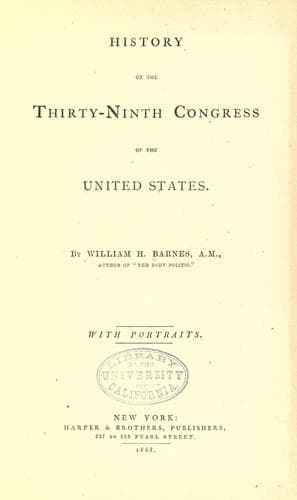
History of the Thirty-Ninth Congress of the United StatesBarnes, William Horatio
History
History of the Thirty-Ninth Congress of the United States
Barnes, William Horatio
United States -- Politics and government -- 1865-1869; United States. Congress (39th : 1865-1867)
Mr. Cowan, of Pennsylvania, spoke against the bill. He said: "The
identical question came up in my State--the question whether the negro
was a citizen, and whether he possessed political power in that
State--and it was there decided that he was not one of the original
corporators, that he was not one of the freemen who originally
possessed political power, and that they had never, by any enactment
or by any act of theirs, admitted him into a participation of that
power, except so far as to tax him for the support of Government. And,
Mr. President, I think it a most important question, and particularly
a most important question for the Pacific coast, and those States
which lie upon it, as to whether this door shall now be thrown open to
the Asiatic population. If it be, there is an end to republican
government there, because it is very well ascertained that those
people have no appreciation of that form of government; it seems to be
obnoxious to their very nature; they seem to be incapable either of
understanding it or of carrying it out; and I can not consent to say
that California, or Oregon, or Colorado, or Nevada, or any of those
States, shall be given over to an irruption of Chinese. I, for my
part, protest against it.
"There is a great deal more in this bill that is exceedingly
objectionable. It is the first time, I think, in the history of
civilized legislation, that a judicial officer has been held up and
subjected to a criminal punishment for that which may have been a
conscientious discharge of his duty. It is, I say, the first case that
I know of, in the legislation of modern and civilized nations, where a
bill of indictment is to take the place of a writ of error, and where
a mistake is to be tortured into a crime.
"I may state that I have another objection to this bill at the present
time; and that is, that the people of several States in the Union are
not represented here, and yet this law is mainly to operate upon those
people. I think it would be at least decent, respectful, if we desire
to maintain and support this Government on the broad foundation upon
which it was laid--namely, the consent of the governed--that we should
wait, at any rate, until the people upon whom it is to operate have a
voice in these halls."
Mr. Cowan then proceeded in a somewhat "devious course," as it was
characterized by another Senator, to make remarks upon the subject of
reconstruction. Many questions and remarks were interposed by other
Senators, giving the discussion an exceedingly colloquial style.
Public-domain text, read in full here on John Shaqi.
Reviews
Reviews
No reviews yet
Be the first to share your thoughts on this work.
Elsewhere in the archive
Join the Discussion
Join the discussion
Sign in to leave a comment or review.
Sign InorCreate an account