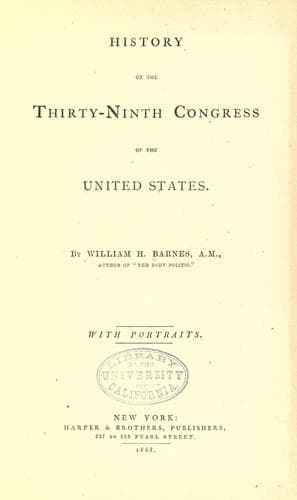
History of the Thirty-Ninth Congress of the United StatesBarnes, William Horatio
History
History of the Thirty-Ninth Congress of the United States
Barnes, William Horatio
United States -- Politics and government -- 1865-1869; United States. Congress (39th : 1865-1867)
Mr. Trumbull replied: "I understood the Senator to challenge me to
produce any proof on that point, and I thought he would like to have
it in his speech. I can assert to him that by a solemn decision of the
Supreme Court of North Carolina, they were citizens before the
adoption of the Constitution."
"If the honorable Senator will allow me," said Mr. Davis, "I will get
along with my remarks."
"I think you will get along better," replied Mr. Trumbull, "by not
being exposed in your statements."
"The honorable Senator is full of conceit, but I have seen less
conceit with a great deal more brains," said Mr. Davis, who then
proceeded "to throw up" what he termed "the main buttress for the
defense of the positions" that he took.
"My main position," said he, "is, that no native-born person of the
United States, of any race or color, can be admitted a citizen of the
United States by Congress under the power conferred in relation to
naturalization by the Constitution upon Congress."
After reading some authorities, the Senator proceeded to say: "A grave
hallucination in this day is to claim all power; and a minor error is
that every thing which passion, or interest, or party power, or any
selfish claims may represent to the judgment or imagination of
gentlemen who belong to strong parties, to be necessary or useful for
the good and the domination of such parties, is seized upon in
defiance of a fair construction of language, in outrage of the plain
meaning of the Constitution. That is not the rule by which our
Constitution is to be interpreted. It is not the rule by which it is
to be administered. On the contrary, if the able, honorable, and
clear-headed Senator from Illinois would do himself and his country
the justice to place himself in the position of the framers of the
Constitution; if he would look all around on the circumstances and
connections of that day, on the purposes of those men not only in
relation to forming a more perfect Union, but also in relation to
securing the blessings of life, liberty, and property to themselves
and their posterity forever; if the honorable Senator would construe
the Constitution according to the light, the sacred and bright light
which such surrounding circumstances would throw upon his intellect,
it seems to me that he would at once abandon this abominable bill, and
would also ask to withdraw its twin sister from the other House that
both might be smothered here together upon the altar of the
Constitution and of patriotism."
At the close of Mr. Davis' speech, much debate and conversation ensued
among various Senators upon a proposed amendment by Mr. Lane, of
Kansas, by which Indians "under tribal authority" should be excluded
from the benefits conferred by this bill. After this question was
disposed of, Mr. Davis was drawn out in another speech by what seemed
to him to be the necessity of defending some positions which he had
assumed. He said:
Public-domain text, read in full here on John Shaqi.
Reviews
Reviews
No reviews yet
Be the first to share your thoughts on this work.
Elsewhere in the archive
Join the Discussion
Join the discussion
Sign in to leave a comment or review.
Sign InorCreate an account