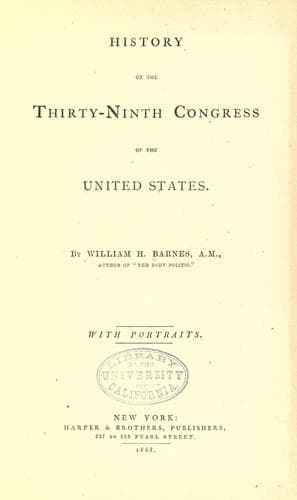
History of the Thirty-Ninth Congress of the United StatesBarnes, William Horatio
History
History of the Thirty-Ninth Congress of the United States
Barnes, William Horatio
United States -- Politics and government -- 1865-1869; United States. Congress (39th : 1865-1867)
"I still reiterate the position that the negro is not a citizen here
according to the essential fundamental principles of our system; but
whether he be a citizen or not, he is not a foreigner, and no man,
white or black, or red or mixed, can be made a citizen by
naturalization unless he is a foreigner."
Mr. Clark, of New Hampshire, interposed: "I wish the Senator from
Kentucky would tell us what constitutes a citizen under the
Constitution."
"A foreigner is not a citizen in the fullest sense of the word at
all," said Mr. Davis.
"The Senator is now telling us," said Mr. Clark, "who is not a
citizen, but my question is, What constitutes a citizen?"
"I leave that to the exercise of your own ingenuity," replied Mr.
Davis.
"That is it," said Mr. Clark. "Washington is dead; Marshall is dead;
Story is dead; I hoped the Senator from Kentucky would have
enlightened us. He says a negro is not a citizen, and a negro is not a
foreigner and can not be made a citizen. He says that a person who
might be and was a citizen before the Constitution, is not a citizen
since the Constitution was adopted. What right was taken away from him
by the Constitution that disqualifies him from being a citizen? The
free negroes in my State, before the Constitution was adopted, were
citizens."
Mr. Davis, having admitted that free negroes were citizens before the
Constitution in New Hampshire, Mr. Clark said:
"I desired that the Senator should tell me what, in his opinion,
constituted a citizen under the Constitution."
Mr. Davis replied: "I will answer the honorable Senator. We sometimes
answer a positive question by declaring what a thing is not. Now, the
honorable Senator asks me what a citizen is. It is easier to answer
what it is not than what it is, and I say that a negro is not a
citizen."
"Well, that is a lucid definition," said Mr. Clark.
"Sufficient for the subject," said Mr. Davis.
"That is begging the question," Mr. Clark replied. "I wanted to find
why a negro was not a citizen, if the gentleman would tell me. If he
would lay down his definition, I wanted to see whether the negro did
not comply with it and conform to it, so as to be a citizen; but he
insists that he is not a citizen."
"I will answer that question, if the honorable Senator will permit
me," said Mr. Davis. "Government is a political partnership. No
persons but the partners who formed the partnership are parties to the
government. Here is a government formed by the white man alone. The
negro was excluded from the formation of our political partnership; he
had nothing to do with it; he had nothing to do in its formation."
"Is it a close corporation, so that new partners can not be added?"
asked Mr. Stewart, of Nevada.
"Yes, sir," said Mr. Davis; "it is a close white corporation. You may
bring all of Europe, but none of Asia and none of Africa into our
partnership."
Public-domain text, read in full here on John Shaqi.
Reviews
Reviews
No reviews yet
Be the first to share your thoughts on this work.
Elsewhere in the archive
Join the Discussion
Join the discussion
Sign in to leave a comment or review.
Sign InorCreate an account