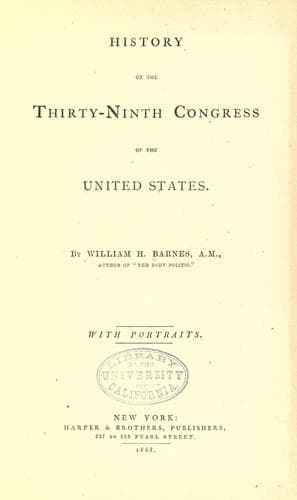
History of the Thirty-Ninth Congress of the United StatesBarnes, William Horatio
History
History of the Thirty-Ninth Congress of the United States
Barnes, William Horatio
United States -- Politics and government -- 1865-1869; United States. Congress (39th : 1865-1867)
On the following day, February 1st, the discussion of the bill was
resumed by Mr. Morrill, of Maine. He said of the bill: "It marks an
epoch in the history of this country, and from this time forward the
legislation takes a fresh and a new departure. Sir, to-day is the only
hour since this Government began when it was possible to have enacted
it. Such has been the situation of politics in this country, nay, sir,
such have been the provisions of the fundamental law of this country,
that such legislation hitherto has never been possible. There has been
no time since the foundation of the Government when an American
Congress could by possibility have enacted such a law, or with
propriety have made such a declaration. What is this declaration? All
persons born in this country are citizens. That never was so before.
Although I have said that by the fundamental principles of American
law all persons were entitled to be citizens by birth, we all know
that there was an exceptional condition in the Government of the
country which provided for an exception to this general rule. Here
were four million slaves in this country that were not citizens, not
citizens by the general policy of the country, not citizens on account
of their condition of servitude; up to this hour they could not have
been treated by us as citizens; so long as that provision in the
Constitution which recognized this exceptional condition remained the
fundamental law of the country, such a declaration as this would not
have been legal, could not have been enacted by Congress. I hail it,
therefore, as a declaration which typifies a grand fundamental change
in the politics of the country, and which change justifies the
declaration now.
"The honorable Senator from Kentucky has vexed himself somewhat, I
think, with the problem of the naturalization of American citizens. As
he reads it, only foreigners can be naturalized, or, in other words,
can become citizens; and upon his assumption, four million men and
women in this country are outside not only of naturalization, not only
of citizenship, but outside of the possibility of citizenship. Sir, he
has forgotten the grand principle both of nature and nations, both of
law and politics, that birth gives citizenship of itself. This is the
fundamental principle running through all modern politics both in this
country and in Europe. Every-where, where the principles of law have
been recognized at all, birth by its inherent energy and force gives
citizenship. Therefore the founders of this Government made no
provision--of course they made none--for the naturalization of
natural-born citizens. The Constitution speaks of 'natural-born,' and
speaks of them as citizens in contradistinction from those who are
alien to us. Therefore, sir, this amendment, although it is a grand
enunciation, although it is a lofty and sublime declaration, has no
force or efficiency as an enactment. I hail it and accept it simply as
a declaration.
Public-domain text, read in full here on John Shaqi.
Reviews
Reviews
No reviews yet
Be the first to share your thoughts on this work.
Elsewhere in the archive
Join the Discussion
Join the discussion
Sign in to leave a comment or review.
Sign InorCreate an account