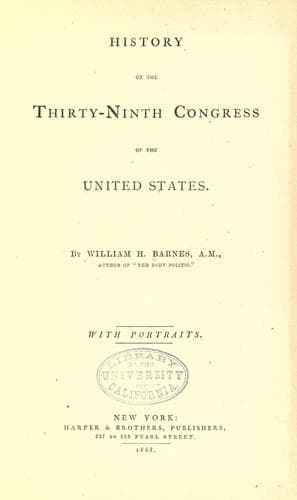
History of the Thirty-Ninth Congress of the United StatesBarnes, William Horatio
History
History of the Thirty-Ninth Congress of the United States
Barnes, William Horatio
United States -- Politics and government -- 1865-1869; United States. Congress (39th : 1865-1867)
"The honorable member reads the Constitution as if it said that none
but white men should become citizens of the United States; but it says
no such thing, and never intended, in my judgment, to say any such
thing. If it had designed to exclude from all participation in the
rights of citizenship certain men on account of color, and to have
confined, at all times thereafter, citizenship to the white race, it
is but fair to presume, looking to the character of the men who framed
the Constitution, that they would have put that object beyond all
possible doubt; they would have said that no man should be a citizen
of the United States except a white man, or rather would have
negatived the right of the negro to become a citizen by saying that
Congress might pass uniform rules upon the subject of the
naturalization of white immigrants and nobody else; but that they did
not do. They left it to Congress. Congress, in the exercise of their
discretion, have thought proper to insert the term 'white' in the
naturalization act; but they may strike it out, and if it should be
stricken out, I do not think any lawyer, except my friend from
Kentucky, would deny that a black man could be naturalized, and by
naturalization become a citizen of the United States.
"But to go back to the point from which the questions of my honorable
friend from Kentucky caused me to digress, we have now within the
United States four million colored people, the descendants of
Africans, whose ancestors were brought into the United States as
chattels. It was because of that condition that they were considered
as not entitled to the rights of citizenship. We have put an end to
that condition. We have said that at all times hereafter men of any
color that nature may think proper to impress upon the human frame,
shall, if within the United States, be free, and not property. Then,
we have four million colored people who are now as free as we are; and
the only question is, whether, being free, they can not be clothed
with the rights of citizenship. The honorable member from Kentucky
says no, because the naturalization clause does not include them. I
have attempted to answer that. He says no, because the act passed in
pursuance of that clause does not include them. I have answered that
by saying that that act in that particular may be changed."
Public-domain text, read in full here on John Shaqi.
Reviews
Reviews
No reviews yet
Be the first to share your thoughts on this work.
Elsewhere in the archive
Join the Discussion
Join the discussion
Sign in to leave a comment or review.
Sign InorCreate an account