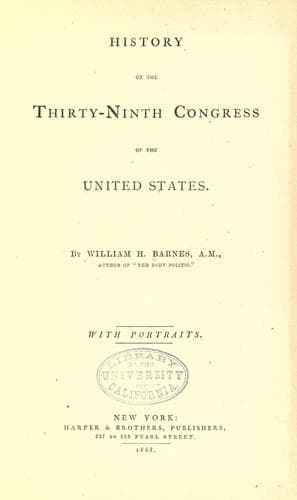
History of the Thirty-Ninth Congress of the United StatesBarnes, William Horatio
History
History of the Thirty-Ninth Congress of the United States
Barnes, William Horatio
United States -- Politics and government -- 1865-1869; United States. Congress (39th : 1865-1867)
Mr. Lane, of Indiana, replied to the argument of his colleague. He
said: "It is true that many of the provisions of this bill, changed in
their purpose and object, are almost identical with the provisions of
the Fugitive Slave Law, and they are denounced by my colleague in
their present application; but I have not heard any denunciation from
my colleague, or from any of those associated with him, of the
provisions of that Fugitive Slave Law which was enacted in the
interest of slavery, and for purposes of oppression, and which was an
unworthy, cowardly, disgraceful concession to Southern opinion by
Northern politicians. I have suffered no suitable opportunity to
escape me to denounce the monstrous character of that Fugitive Slave
Act of 1850. All these provisions were odious and disgraceful in my
opinion, when applied in the interest of slavery, when the object was
to strike down the rights of man. But here the purpose is changed.
These provisions are in the interest of freemen and of freedom, and
what was odious in the one case becomes highly meritorious in the
other. It is an instance of poetic justice and of apt retribution that
God has caused the wrath of man to praise Him. I stand by every
provision of this bill, drawn as it is from that most iniquitous
fountain, the Fugitive Slave Law of 1850.
"Then my colleague asks, Why do you invoke the power of the military
to enforce these laws? And he says that constables, and sheriffs, and
marshals, when they have process to serve, have a right to call upon
the _posse comitatus_, the body of the whole people, to enforce their
writs. Here is a justice of the peace in South Carolina or Georgia, or
a county court, or a circuit court, that is called upon to execute
this law. They appoint their own marshal, their deputy marshal, or
their constable, and he calls upon the _posse comitatus_. Neither the
judge, nor the jury, nor the officer, as we believe, is willing to
execute the law. He may call upon the people, the body of the whole
people, a body of rebels steeped in treason and rebellion to their
lips, and they are to execute it; and the gentleman seems wonderfully
astonished that we should call upon the military power. We should not
legislate at all if we believed the State courts could or would
honestly carry out the provisions of the constitutional amendment; but
because we believe they will not do that, we give the Federal officers
jurisdiction.
Public-domain text, read in full here on John Shaqi.
Reviews
Reviews
No reviews yet
Be the first to share your thoughts on this work.
Elsewhere in the archive
Join the Discussion
Join the discussion
Sign in to leave a comment or review.
Sign InorCreate an account