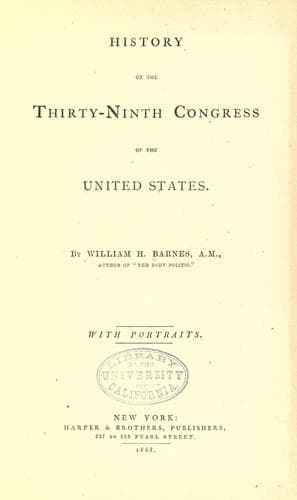
History of the Thirty-Ninth Congress of the United StatesBarnes, William Horatio
History
History of the Thirty-Ninth Congress of the United States
Barnes, William Horatio
United States -- Politics and government -- 1865-1869; United States. Congress (39th : 1865-1867)
"But what harm is to result from it? Who is to be oppressed? What
white man fleeing, in the language of my colleague, pursued by these
harpies of the law, is in danger of having his rights stricken down?
What does the bill provide? It places all men upon an equality, and
unless the white man violates the law, he is in no danger. It takes no
rights from any white man. It simply places others on the same
platform upon which he stands; and if he would invoke the power of
local prejudice to override the laws of the country, this is no
Government unless the military may be called in to enforce the order
of the civil courts and obedience to the laws of the country."
Mr. Wilson, of Massachusetts, said, in answer to some objections to
the bill urged by Mr. Guthrie: "The Senator tells us that the
emancipated men ought to have their civil rights, that the black codes
fell with slavery; but the Senator forgets that at least six of the
reoerganized States in their new Legislatures have passed laws wholly
incompatible with the freedom of these freedmen; and so atrocious are
the provisions of these laws, and so persistently are they carried
into effect by the local authorities, that General Thomas, in
Mississippi, General Swayne, in Alabama, General Sickles, in South
Carolina, and General Terry, in Virginia, have issued positive orders,
forbidding the execution of the black laws that have just been passed.
"So unjust, so wicked, so incompatible are these new black laws of the
rebel States, made in defiance of the expressed will of the nation,
that Lieutenant-general Grant has been forced to issue that order,
which sets aside the black laws of all these rebellious States against
the freedmen, and allows no law to be enforced against them that is
not enforced equally against white men. This order, issued by General
Grant, will be respected, obeyed, and enforced in the rebel States
with the military power of the nation. Southern legislators and people
must learn, if they are compelled to learn by the bayonets of the Army
of the United States, that the civil rights of the freedmen must be
and shall be respected; that these freedmen are as free as their late
masters; that they shall live under the same laws, be tried for their
violation in the same manner, and if found guilty, punished in the
same manner and degree.
Public-domain text, read in full here on John Shaqi.
Reviews
Reviews
No reviews yet
Be the first to share your thoughts on this work.
Elsewhere in the archive
Join the Discussion
Join the discussion
Sign in to leave a comment or review.
Sign InorCreate an account