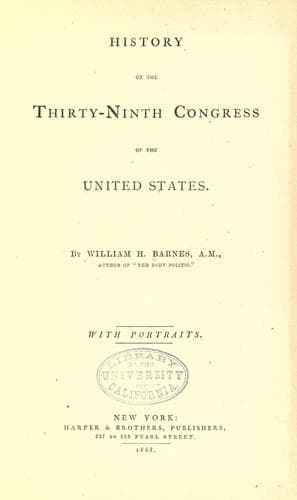
History of the Thirty-Ninth Congress of the United StatesBarnes, William Horatio
History
History of the Thirty-Ninth Congress of the United States
Barnes, William Horatio
United States -- Politics and government -- 1865-1869; United States. Congress (39th : 1865-1867)
"This measure is called for, because these reconstructed Legislatures,
in defiance of the rights of the freedmen, and the will of the nation,
embodied in the amendment to the Constitution, have enacted laws
nearly as iniquitous as the old slave codes that darkened the
legislation of other days. The needs of more than four million colored
men imperatively call for its enactment. The Constitution authorizes
and the national will demands it. By a series of legislative acts, by
executive proclamations, by military orders, and by the adoption of
the amendment to the Constitution by the people of the United States,
the gigantic system of human slavery that darkened the land,
controlled the policy, and swayed the destinies of the republic has
forever perished. Step by step we have marched right on from one
victory to another, with the music of broken fetters ringing in our
ears. None of the series of acts in this beneficent legislation of
Congress, none of the proclamations of the Executive, none of these
military orders, protecting rights secured by law, will ever be
revoked or amended by the voice of the American people. There is now
"'No slave beneath that starry flag,
The emblem of the free.'
"By the will of the nation freedom and free institutions for all,
chains and fetters for none, are forever incorporated in the
fundamental law of regenerated and united America. Slave codes and
auction blocks, chains and fetters and blood-hounds, are things of the
past, and the chattel stands forth a man, with the rights and the
powers of the freemen. For the better security of these new-born civil
rights we are now about to pass the greatest and the grandest act in
this series of acts that have emancipated a race and disinthralled a
nation. It will pass, it will go upon the statute-book of the republic
by the voice of the American people, and there it will remain. From
the verdict of Congress in favor of this great measure, no appeal will
ever be entertained by the people of the United States."
Mr. Cowan spoke again, and denounced the section of the bill which
provided for its enforcement by the military. He said: "There it is;
words can not make it plainer; reason can not elucidate it; no
language can strengthen it or weaken it, one way or the other. There
is the question whether a military man, educated in a military school,
accustomed to supreme command, unaccustomed to the administration of
civil law among a free people, is to be intrusted with these appellate
jurisdiction over the courts of the country; whether he can in any
way, whether he ought in any way, to be intrusted with such a power.
I, for my part, will never agree to it; and I should feel myself
recreant to every duty that I owed to myself, to my country, to my
country's history, and I may say to the race which has been for
hundreds and thousands of years endeavoring to attain to something
like constitutional liberty, if I did not resist this and all similar
projects."
Public-domain text, read in full here on John Shaqi.
Reviews
Reviews
No reviews yet
Be the first to share your thoughts on this work.
Elsewhere in the archive
Join the Discussion
Join the discussion
Sign in to leave a comment or review.
Sign InorCreate an account