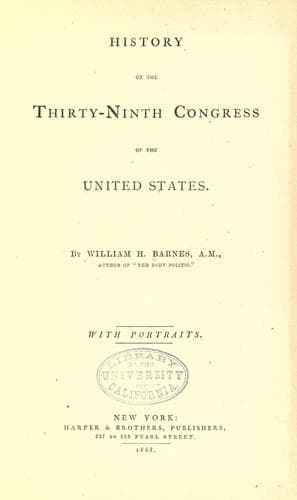
History of the Thirty-Ninth Congress of the United StatesBarnes, William Horatio
History
History of the Thirty-Ninth Congress of the United States
Barnes, William Horatio
United States -- Politics and government -- 1865-1869; United States. Congress (39th : 1865-1867)
"Let me read a clause from the Constitution, which seems to have been
forgotten by the Senator from Pennsylvania and the Senator from
Indiana. The Senator from Pennsylvania, who has denounced this law,
has been living under just such a law for thirty years, and it seems
never found it out. What says the Constitution? 'Congress shall have
power to provide for calling forth the militia to execute the laws of
the Union.'
"Then, can not the militia prevent persons from violating the law?
They are authorized by the Constitution to be called out for, the
purpose of executing the law, and here we have a law that is to be
carried into execution, and when you find persons combined together to
prevent its execution, you can not do any thing with them! Suppose
that the county authorities in Muscogee County, Georgia, combine
together to deny civil rights to every colored man in that county.
For the purpose of preventing it, before they have done any act, I say
the militia may be called out to prevent them from committing an act.
We are not required to wait until the act is committed before any
thing can be done. That was the doctrine which led to this rebellion,
that we had no authority to do any thing till the conflict of arms
came. I believed then, in 1860, that we had authority; and if it had
been properly exercised, if the men who were threatening rebellion,
who were in this chamber defying the authority of the Government, had
been arrested for treason--of which, in my judgment, by setting on
foot armed expeditions against the country, they were guilty--and if
they had been tried and punished and executed for the crime, I doubt
whether this great rebellion would ever have taken place.
"There is another statute to which I beg leave to call the attention
of the Senator from Pennsylvania, and under which he has lived for
thirty years without ever having known it; and his rights have been
fully protected. I wish to call attention to a section from which the
tenth section of the bill under consideration, at which the Senator
from Indiana is so horrified, is copied word for word, and letter for
letter. The act of March 10, 1836, 'supplementary to an act entitled
"An act in addition to the act for the punishment of certain crimes
against the United States, and to repeal the acts therein mentioned,"
approved 20th of April, 1818,' contains the very section that is in
this bill, word for word. It did not horrify the country; it did not
destroy all the liberties of the people; it did not consolidate all
the powers of the Constitution in the Federal Government; it did not
overthrow the courts, and it has existed now for thirty years!"
The question was first taken on the amendment offered by Mr.
Hendricks, to strike out the tenth section of the bill. The vote
resulted yeas, twelve; nays, thirty-four.
Public-domain text, read in full here on John Shaqi.
Reviews
Reviews
No reviews yet
Be the first to share your thoughts on this work.
Elsewhere in the archive
Join the Discussion
Join the discussion
Sign in to leave a comment or review.
Sign InorCreate an account