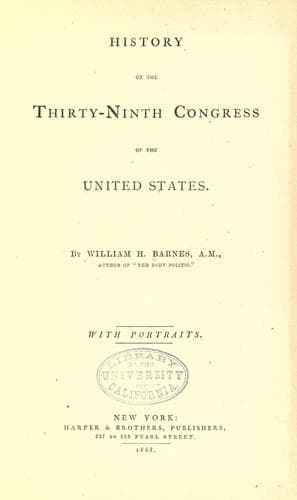
History of the Thirty-Ninth Congress of the United StatesBarnes, William Horatio
History
History of the Thirty-Ninth Congress of the United States
Barnes, William Horatio
United States -- Politics and government -- 1865-1869; United States. Congress (39th : 1865-1867)
At this stage of the proceedings, Mr. Saulsbury moved to amend the
bill by adding in the first section of the bill after the words "civil
rights," the words, "except the right to vote in the States." He
desired that if the Senate did not wish to confer the right of
suffrage by this bill, they should say so. The question being taken on
Mr. Saulsbury's amendment, the vote resulted seven in the affirmative
and thirty-nine in the negative.
The vote was finally taken on the passage of the bill, which resulted
thirty-three in the affirmative and twelve in the negative. The
following Senators voted in favor of the bill:
Messrs. Anthony, Brown, Chandler, Clark, Connor, Cragin,
Dixon, Fessenden, Foot, Foster, Harris, Henderson, Howard,
Howe, Kirkwood, Henry S. Lane, James H. Lane, Morgan,
Morrill, Nye, Poland, Pomeroy, Ramsey, Sherman, Sprague,
Stewart, Sumner, Trumbull, Wade, Willey, Williams, Wilson,
and Yates--33.
The following voted against the bill, namely:
Messrs. Buckalew, Cowan, Davis, Guthrie, Hendricks,
McDougall, Nesmith, Norton, Riddle, Saulsbury, Stockton, and
Van Winkle--12.
Five Senators were absent, to wit:
Messrs. Creswell, Doolittle, Grimes, Johnson, and Wright--5.
CHAPTER X.
THE CIVIL RIGHTS BILL IN THE HOUSE OF REPRESENTATIVES.
The Bill referred to the Judiciary Committee and reported
back -- Speech by the Chairman of the Committee -- Mr.
Rogers -- Mr. Cook -- Mr. Thayer -- Mr. Eldridge -- Mr.
Thornton -- Mr. Windom -- Mr. Shellabarger -- Mr. Broomall
-- Mr. Raymond -- Mr. Delano -- Mr. Kerr -- Amendment by Mr.
Bingham -- His Speech -- Reply by his Colleague --
Discussion closed by Mr. Wilson -- Yeas and Nays on the
Passage of the Bill -- Mr. Le Blond's proposed title --
Amendments of the House accepted by the Senate.
On the 5th of February, four days after the passage of the Civil Rights
Bill in the Senate, it came before the House of Representatives, and
having been read a first and second time, was referred to the
Committee on the Judiciary. On the 1st of March, the Chairman of the
Judiciary Committee, Mr. Wilson, brought the bill again before the
House, proposing some verbal amendments which were adopted. He then
made a motion to recommit the bill, pending which, he made a speech on
the merits of the measure. He referred to many definitions, judicial
decisions, opinions, and precedents, under which negroes were entitled
to the rights of American citizenship. In reference to the results of
his researches, he said:
Public-domain text, read in full here on John Shaqi.
Reviews
Reviews
No reviews yet
Be the first to share your thoughts on this work.
Elsewhere in the archive
Join the Discussion
Join the discussion
Sign in to leave a comment or review.
Sign InorCreate an account