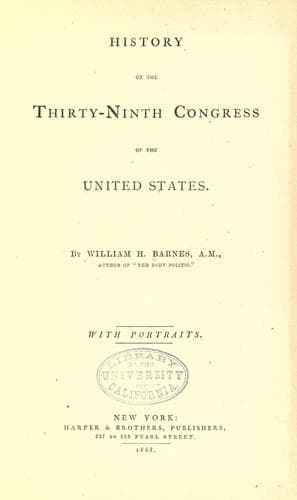
History of the Thirty-Ninth Congress of the United StatesBarnes, William Horatio
History
History of the Thirty-Ninth Congress of the United States
Barnes, William Horatio
United States -- Politics and government -- 1865-1869; United States. Congress (39th : 1865-1867)
"Upon this broad principle I rest my justification of this bill. I
assert that we possess the power to do those things which governments
are organized to do; that we may protect a citizen of the United
States against a violation of his rights by the law of a single State;
that by our laws and our courts we may intervene to maintain the proud
character of American citizenship; that this power permeates our whole
system, is a part of it, without which the States can run riot over
every fundamental right belonging to citizens of the United States;
that the right to exercise this power depends upon no express
delegation, but runs with the rights it is designed to protect; that
we possess the same latitude in respect to the selection of means
through which to exercise this power that belongs to us when a power
rests upon express delegation; and that the decisions which support
the latter maintain the former. And here, sir, I leave the bill to the
consideration of the House."
Mr. Rogers, of New Jersey, followed with an argument against the bill,
because it interfered with "States' Rights." Under its provisions,
Congress would "enter the domain of a State and interfere with its
internal police, statutes, and domestic regulations." He said:
"This act of legislation would destroy the foundations of the
Government as they were laid and established by our fathers, who
reserved to the States certain privileges and immunities which ought
sacredly to be preserved to them.
"If you had attempted to do it in the days of those who were living at
the time the Constitution was made, after the birth of that noble
instrument, the spirit of the heroes of the Revolution and the ghosts
of the departed who laid down their lives in defense of the liberty of
this country and of the rights of the States, would have come forth as
witnesses against the deadly infliction, and the destruction of the
fundamental principle of the sovereignty of the States in violation of
the Constitution, and the breaking down of the ties that bind the
States, and the violation of the rights and liberties of the white men
and white women of America.
"If you pass this bill, you will allow the negroes of this country to
compete for the high office of President of the United States. Because
if they are citizens at all, they come within the meaning and letter
of the Constitution of the United States, which allows all
natural-born citizens to become candidates for the Presidency, and to
exercise the duties of that office if elected.
Public-domain text, read in full here on John Shaqi.
Reviews
Reviews
No reviews yet
Be the first to share your thoughts on this work.
Elsewhere in the archive
Join the Discussion
Join the discussion
Sign in to leave a comment or review.
Sign InorCreate an account