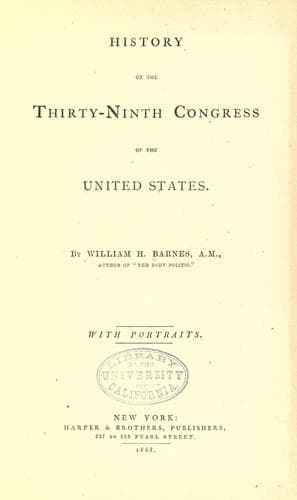
History of the Thirty-Ninth Congress of the United StatesBarnes, William Horatio
History
History of the Thirty-Ninth Congress of the United States
Barnes, William Horatio
United States -- Politics and government -- 1865-1869; United States. Congress (39th : 1865-1867)
"Precedents, both judicial and legislative, are found in sharp
conflict concerning them. The line which divides these precedents is
generally found to be the same which separates the early from the
later days of the republic. The further the Government drifted from
the old moorings of equality and human rights, the more numerous
became judicial and legislative utterances in conflict with some of
the leading features of this bill."
He argued that the section of the bill providing for its enforcement
by the military arm was necessary, in order "to fortify the
declaratory portions of this bill with such sanctions as will render
it effective." In conclusion he said:
"Can not protection be rendered to the citizen in the mode prescribed
by the measure we now have under consideration? If not, a perpetual
state of constructive war would be a great blessing to very many
American citizens. If a suspension of martial law and a restoration of
the ordinary forms of civil law are to result in a subjection of our
people to the outrages under the operation of State laws and municipal
ordinances which these orders now prevent, then it were better to
continue the present state of affairs forever. But such is not the
case; we may provide by law for the same ample protection through the
civil courts that now depends on the orders of our military
commanders; and I will never consent to any other construction of our
Constitution, for that would be the elevation of the military above
the civil power.
"Before our Constitution was formed, the great fundamental rights
which I have mentioned belonged to every person who became a member of
our great national family. No one surrendered a jot or tittle of these
rights by consenting to the formation of the Government. The entire
machinery of Government, as organized by the Constitution, was
designed, among other things, to secure a more perfect enjoyment of
these rights. A legislative department was created, that laws
necessary and proper to this end might be enacted; a judicial
department was erected to expound and administer the laws; an
executive department was formed for the purpose of enforcing and
seeing to the execution of these laws; and these several departments
of Government possess the power to enact, administer, and enforce the
laws 'necessary and proper' to secure those rights which existed
anterior to the ordination of the Constitution. Any other view of the
powers of this Government dwarfs it, and renders it a failure in its
most important office.
Public-domain text, read in full here on John Shaqi.
Reviews
Reviews
No reviews yet
Be the first to share your thoughts on this work.
Elsewhere in the archive
Join the Discussion
Join the discussion
Sign in to leave a comment or review.
Sign InorCreate an account