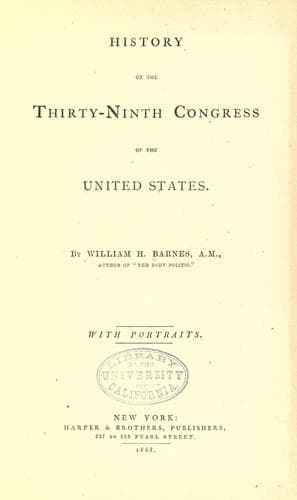
History of the Thirty-Ninth Congress of the United StatesBarnes, William Horatio
History
History of the Thirty-Ninth Congress of the United States
Barnes, William Horatio
United States -- Politics and government -- 1865-1869; United States. Congress (39th : 1865-1867)
"There is nothing in this bill in respect to the employment of
military force that is not already in the Constitution of the United
States. The power here conferred is expressly given by that
instrument, and has been exercised upon the most stupendous scale in
the suppression of the rebellion. What is this bill? I hope gentlemen,
even on the opposite side of the House, will not suffer their minds to
be influenced by any such vague, loose, and groundless denunciations
as these which have proceeded from the gentleman from New Jersey. The
bill, after extending these fundamental immunities of citizenship to
all classes of people in the United States, simply provides means for
the enforcement of these rights and immunities. How? Not by military
force, not through the instrumentality of military commanders, not
through any military machinery whatever, but through the quiet,
dignified, firm, and constitutional forms of judicial procedure. The
bill seeks to enforce these rights in the same manner and with the
same sanctions under and by which other laws of the United States are
enforced. It imposes duties upon the judicial tribunals of the country
which require the enforcement of these rights. It provides for the
administration of laws to protect these rights. It provides for the
execution of laws to enforce them. Is there any thing appalling in
that? Is that a military despotism? Sir, it is a strange abuse of
language to say that a military despotism is established by wholesome
and equal laws. Yet the gentleman declaimed by the hour, in vague and
idle terms, against this bill, which has not a single offensive,
oppressive, unjust, unusual, or tyrannical feature in it. These civil
rights and immunities which are to be secured, and which no man can
conscientiously say ought to be denied, are to be enforced through the
ordinary instrumentalities of courts of justice.
"While engaged in this great work of restoration, it concerns our
honor that we forget not those who are unable to help themselves; who,
whatever may have been the misery and wretchedness of their former
condition, were on our side in the great struggle which has closed,
and whose rights we can not disregard or neglect without violating the
most sacred obligations of duty and of honor. To us they look for
protection against the wrongs with which they are threatened. To us
alone can they appeal in their helplessness for succor and defense. To
us they hold out to-day their supplicating hands, asking for
protection for themselves and their posterity. We can not disregard
this appeal, and stand acquitted before the country and the world of
basely abandoning to a miserable fate those who have a right to demand
the protection of your flag and the immunities guaranteed to every
freeman by your Constitution."
Mr. Eldridge, of Wisconsin, opposed the bill, in a speech of which the
following are the concluding remarks:
Public-domain text, read in full here on John Shaqi.
Reviews
Reviews
No reviews yet
Be the first to share your thoughts on this work.
Elsewhere in the archive
Join the Discussion
Join the discussion
Sign in to leave a comment or review.
Sign InorCreate an account