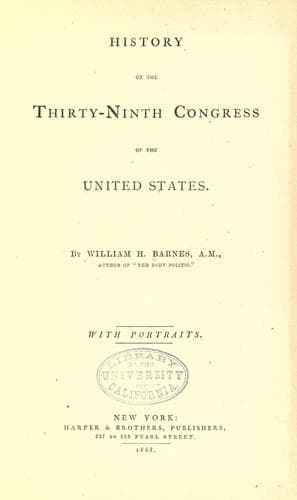
History of the Thirty-Ninth Congress of the United StatesBarnes, William Horatio
History
History of the Thirty-Ninth Congress of the United States
Barnes, William Horatio
United States -- Politics and government -- 1865-1869; United States. Congress (39th : 1865-1867)
"I had hoped that this subject would be allowed to rest. Gentlemen
refer us to individual cases of wrong perpetrated upon the freedmen of
the South as an argument why we should extend the Federal authority
into the different States to control the action of the citizens
thereof. But, I ask, has not the South submitted to the altered state
of things there, to the late amendment of the Constitution, to the
loss of their slave property, with a cheerfulness and grace that we
did not expect? Have they not acquiesced more willingly than we dared
to hope? Then why not trust them? Why not meet them with frankness and
kindness? Why not encourage them with trust and confidence?
"I deprecate all these measures because of the implication they carry
upon their face, that the people who have heretofore owned slaves
intend to do them wrong. I do not believe it. So far as my knowledge
goes, and so far as my information extends, I believe that the people
who have held the freedmen slaves will treat them with more kindness,
with more leniency, than those of the North who make such loud
professions of love and affection for them, and are so anxious to pass
these bills. They know their nature; they know their wants; they know
their habits; they have been brought up together, and have none of the
prejudices and unkind feelings which many in the North would have,
toward them.
"I do not credit all these stories about the general feeling of
hostility in the South toward the negro. So far as I have heard
opinions expressed upon that subject, and I have conversed with many
persons from that section of the country, they do not blame the negro
for any thing that has happened. As a general thing, he was faithful
to them and their interests until the army reached the place and took
him from them. He has supported their wives and children in the
absence of the husbands and fathers in the armies of the South. He has
done for them what no one else could have done. They recognize his
general good feeling toward them, and are inclined to reciprocate that
feeling toward him.
"I believe that is the general feeling of the Southern people to-day.
The cases of ill-treatment are exceptional cases. They are like the
cases which have occurred in the Northern States where the unfortunate
have been thrown upon our charity. Take for instance the stories of
the cruel treatment of the insane in the State of Massachusetts. They
may have been barbarously confined in the loathsome dens, as stated in
particular instances, but is that any evidence of the general ill-will
of the people of the State of Massachusetts toward the insane? Is that
any reason why the Federal arm should be extended to Massachusetts to
control and protect the insane there?
Public-domain text, read in full here on John Shaqi.
Reviews
Reviews
No reviews yet
Be the first to share your thoughts on this work.
Elsewhere in the archive
Join the Discussion
Join the discussion
Sign in to leave a comment or review.
Sign InorCreate an account