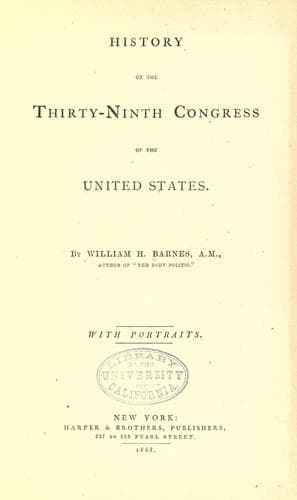
History of the Thirty-Ninth Congress of the United StatesBarnes, William Horatio
History
History of the Thirty-Ninth Congress of the United States
Barnes, William Horatio
United States -- Politics and government -- 1865-1869; United States. Congress (39th : 1865-1867)
Mr. Windom, of Minnesota, next obtained the floor. Referring to the
speech of Mr. Rogers, he said: "I wish to make another extract from
the speech of the gentleman from New Jersey. He said, 'If you pass
this bill, you will allow negroes to compete for the high office of
the President of the United States.' You will actually allow them to
compete for the Presidency of the United States! As for this fear
which haunts the gentleman from New Jersey, if there is a negro in the
country who is so far above all the white men of the country that only
four millions of his own race can elect him President of the United
States over twenty-six millions of white people, I think we ought to
encourage such talent in the country.
"Sir, the gentleman has far less confidence in the white race than I
have, if he is so timid in regard to negro competition. Does he really
suppose that black men are so far superior to white men that four
millions of them can elect a President of their own race against the
wishes of thirty millions of ours? Ever since I knew any thing of the
party to which the gentleman belongs, it has entertained this same
morbid fear of negro competition; and sometimes I have thought that if
we were to contemplate the subject from their stand-point we would
have more charity than we do for this timidity and nervous dread which
haunts them. I beg leave, however, to assure the gentleman that there
is not the slightest danger of electing a black President, and that he
need never vote for one, unless he thinks him better fitted for the
office than a white man."
With more direct reference to the merits of the question, Mr. Windom
said: "Our warrant for the passage of this bill is found in the genius
and spirit of our institutions; but not in these alone. Fortunately,
the great amendment which broke the shackles from every slave in the
land contains an express provision that 'Congress shall have power to
enforce this article by appropriate legislation.'
Public-domain text, read in full here on John Shaqi.
Reviews
Reviews
No reviews yet
Be the first to share your thoughts on this work.
Elsewhere in the archive
Join the Discussion
Join the discussion
Sign in to leave a comment or review.
Sign InorCreate an account