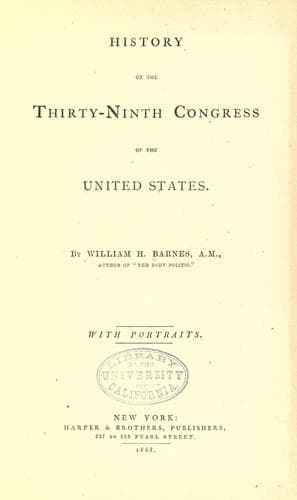
History of the Thirty-Ninth Congress of the United StatesBarnes, William Horatio
History
History of the Thirty-Ninth Congress of the United States
Barnes, William Horatio
United States -- Politics and government -- 1865-1869; United States. Congress (39th : 1865-1867)
"It has also been said that certain paupers in certain States have
been badly used--paupers, too, who were whites. Is that any reason why
we should extend the arm of the Federal Government to those States to
protect the poor who are thrown upon the charities of the people
there?
"Sir, we must yield to the altered state of things in this country. We
must trust the people; it is our duty to do so; we can not do
otherwise. And the sooner we place ourselves in a position where we
can win the confidence of our late enemies, where our counsels will be
heeded, where our advice may be regarded, the sooner will the people
of the whole country be fully reconciled to each other and their
changed relationship; the sooner will all the inhabitants of our
country be in the possession of all the rights and immunities
essential to their prosperity and happiness."
Mr. Thornton, of Illinois, feared there was "something hidden,
something more than appears in the language" of the bill. He feared "a
design to confer the right of suffrage upon the negro," and urged that
a proviso should be accepted "restricting the meaning of the words
'civil rights and immunities.'" He remarked further: "The most serious
objection that I have to this bill is, that it is an interference with
the rights of the South. It was remarked by my friend from Wisconsin
that it has often been intimated on this floor, and throughout the
country, that whenever a man talks about either the Constitution or
the rights of the States, he is either a traitor or a sympathizer with
treason. I do not assume that the States are sovereign. They are
subordinate to the Federal Government. Sovereignty in this country is
in the people, but the States have certain rights, and those rights
are absolutely necessary to the maintenance of our system of
government. What are those rights? The right to determine and fix the
legal _status_ of the inhabitants of the respective States; the local
powers of self-government; the power to regulate all the relations
that exist between husband and wife, parent and child, guardian and
ward; all the fireside and home rights, which are nearer and dearer to
us than all others.
"Sir, this is but a stepping-stone to a centralization of the
Government and the overthrow of the local powers of the States.
Whenever that is consummated, then farewell to the beauty, strength,
and power of this Government. There is nothing left but absolute,
despotic, central power. It lives no longer but as a naked despotism.
There is nothing left to admire and to cherish."
Public-domain text, read in full here on John Shaqi.
Reviews
Reviews
No reviews yet
Be the first to share your thoughts on this work.
Elsewhere in the archive
Join the Discussion
Join the discussion
Sign in to leave a comment or review.
Sign InorCreate an account