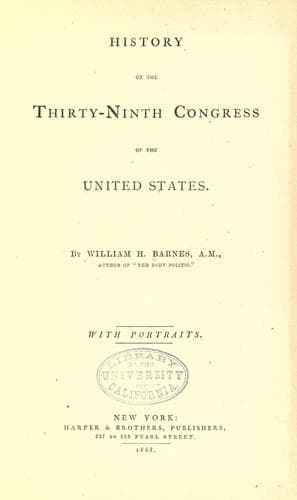
History of the Thirty-Ninth Congress of the United StatesBarnes, William Horatio
History
History of the Thirty-Ninth Congress of the United States
Barnes, William Horatio
United States -- Politics and government -- 1865-1869; United States. Congress (39th : 1865-1867)
Mr. Raymond, of New York, was impressed with the importance of the
measure. "Whether we consider it by itself, simply as a proposed
statute, or in its bearings upon the general question of the
restoration of peace and harmony to the Union, I regard it as one of
the most important bills ever presented to this House for its action,
worthy, in every respect, to enlist the coolest and the calmest
judgment of every member whose vote must be recorded upon it."
He was in favor of the first part of the bill, which declares "who
shall be citizens of the United States, and declares that all shall be
citizens without distinction of race, color, or previous condition of
servitude, who are, have been, or shall be born within the limits and
jurisdiction of the United States.
"Now, sir, assuming, as I do, without any further argument, that
Congress has the power of admitting to citizenship this great class of
persons just set free by the amendment to the Constitution of the
United States abolishing slavery, I suppose I need not dwell here on
the great importance to that class of persons of having this boon
conferred upon them.
"We have already conferred upon them the great, inestimable, priceless
boon of personal liberty. I can not for one moment yield to what seems
to be a general disposition to disparage the freedom we have given
them. I think the fact that we have conferred upon four million people
that personal liberty and freedom from servitude from this time
forward for evermore, is one of the highest and most beneficent acts
ever performed by any Government toward so large a class of its
people.
"Having gone thus far, I desire to go on by successive steps still
further, and to elevate them in all respects, so far as their
faculties will allow and our power will permit us to do, to an
equality with the other persons and races in this country. I desire,
as the next step in the process of elevating that race, to give them
the rights of citizenship, or to declare by solemn statute that they
are citizens of the United States, and thus secure to them whatever
rights, immunities, privileges, and powers belong as of right to all
citizens of the United States. I hope no one will be prepared or
inclined to say this is a trifling boon. If we do so estimate this
great privilege, I fear we are scarcely in the frame of mind to act
upon the great questions coming before us from day to day here. I, for
one, am not prepared or inclined to disparage American citizenship as
a personal qualification belonging to myself, or as conferred upon any
of our fellow-citizens."
Mr. Raymond expressed doubts as to the constitutionality of that part
of the bill "that provides for that class of persons thus made
citizens protection against anticipated inequality of legislation in
the several States."
Public-domain text, read in full here on John Shaqi.
Reviews
Reviews
No reviews yet
Be the first to share your thoughts on this work.
Elsewhere in the archive
Join the Discussion
Join the discussion
Sign in to leave a comment or review.
Sign InorCreate an account